
Advocacy
The Mental Health Gold Rush
How venture capital and for-profit holding companies are cashing in on America’s mental health crisis, and what it will cost all of us.
Published by StartHere.care
The Crisis Beneath the Crisis
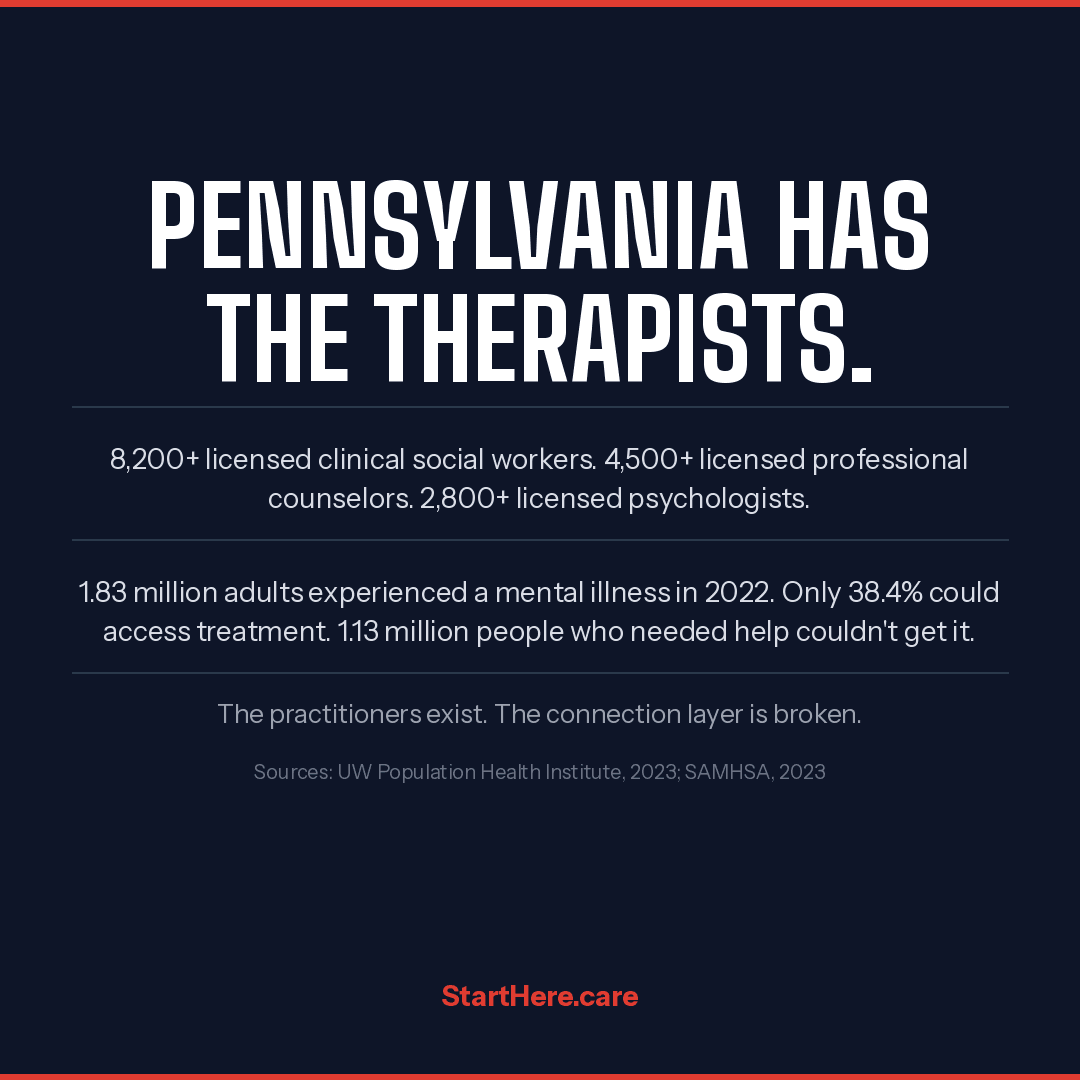
America is in the middle of a mental health crisis. That much is not in dispute. Rates of anxiety and depression have climbed steadily for more than a decade, accelerated sharply through the pandemic years, and have not come back down. Demand for therapists, counselors, and psychiatric care has outpaced supply in nearly every corner of the country. Waitlists stretch for months. Entire rural regions have no licensed providers at all.
But underneath that crisis, feeding on it, a second phenomenon is unfolding. Venture capital firms, private equity groups, and for-profit holding companies have identified mental health as one of the most compelling investment opportunities of this generation. And they are moving fast.
This is not an argument against profit. It is an argument about what happens when the profit motive is applied to a broken market in a way that extracts more than it contributes, and what that means for the people who need care, the providers who deliver it, and the communities trying to hold things together.
When you treat a mental health crisis as a gold rush, the people who suffer most are the ones who were already suffering.
Who Is Coming In, and Why
The investment thesis is straightforward: mental health is a massive, underserved, high-demand market with fragmented supply, growing insurance coverage mandates, and a workforce that has historically undercharged for its services. From a pure returns standpoint, it checks a lot of boxes.
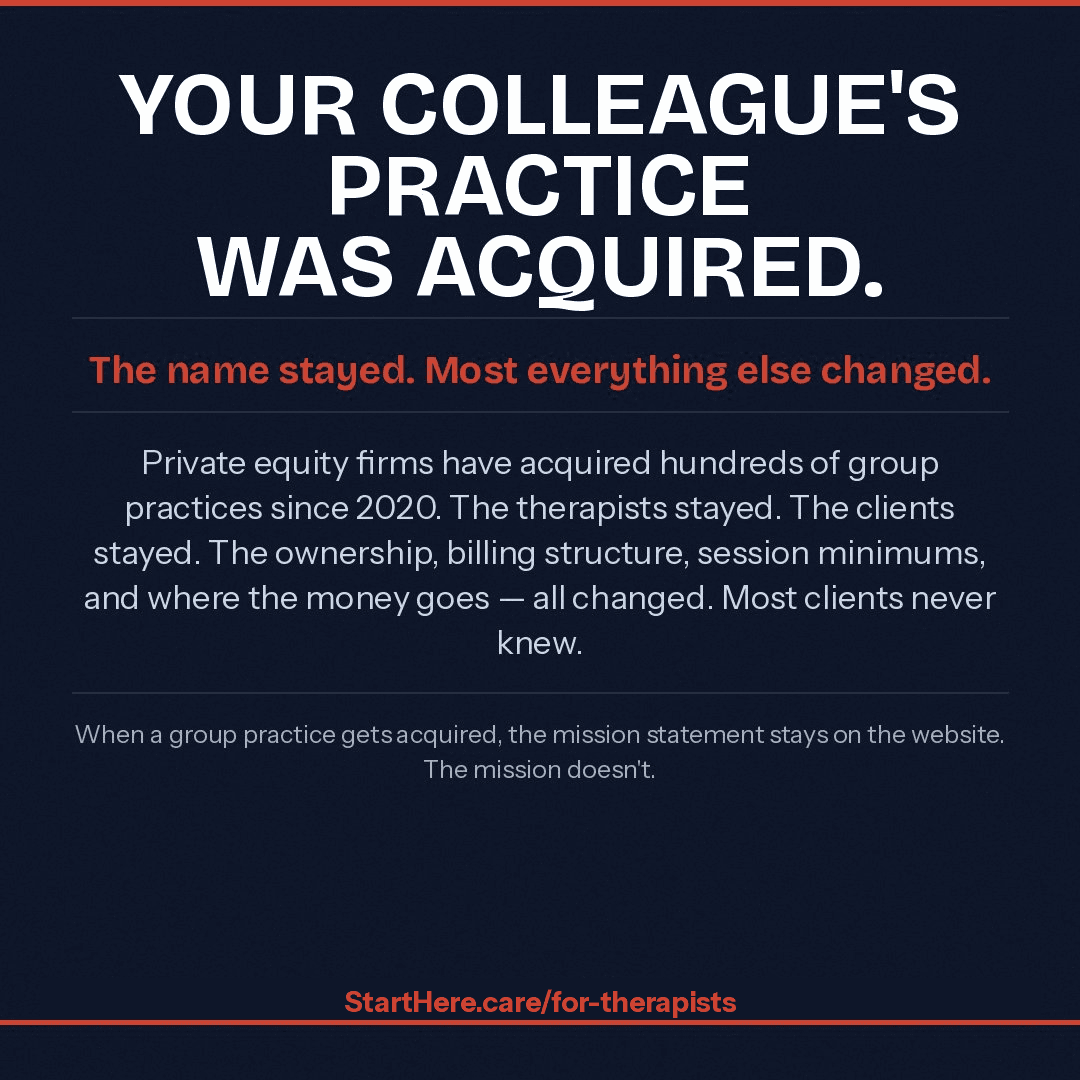
Private equity firms have been acquiring therapy practices, behavioral health clinics, and telehealth platforms at a remarkable pace. The model is familiar from other healthcare sectors: buy up independent practices, consolidate them under a holding company structure, extract operational efficiencies, push for higher volume, and either hold for cash flow or flip to a larger entity or public market.
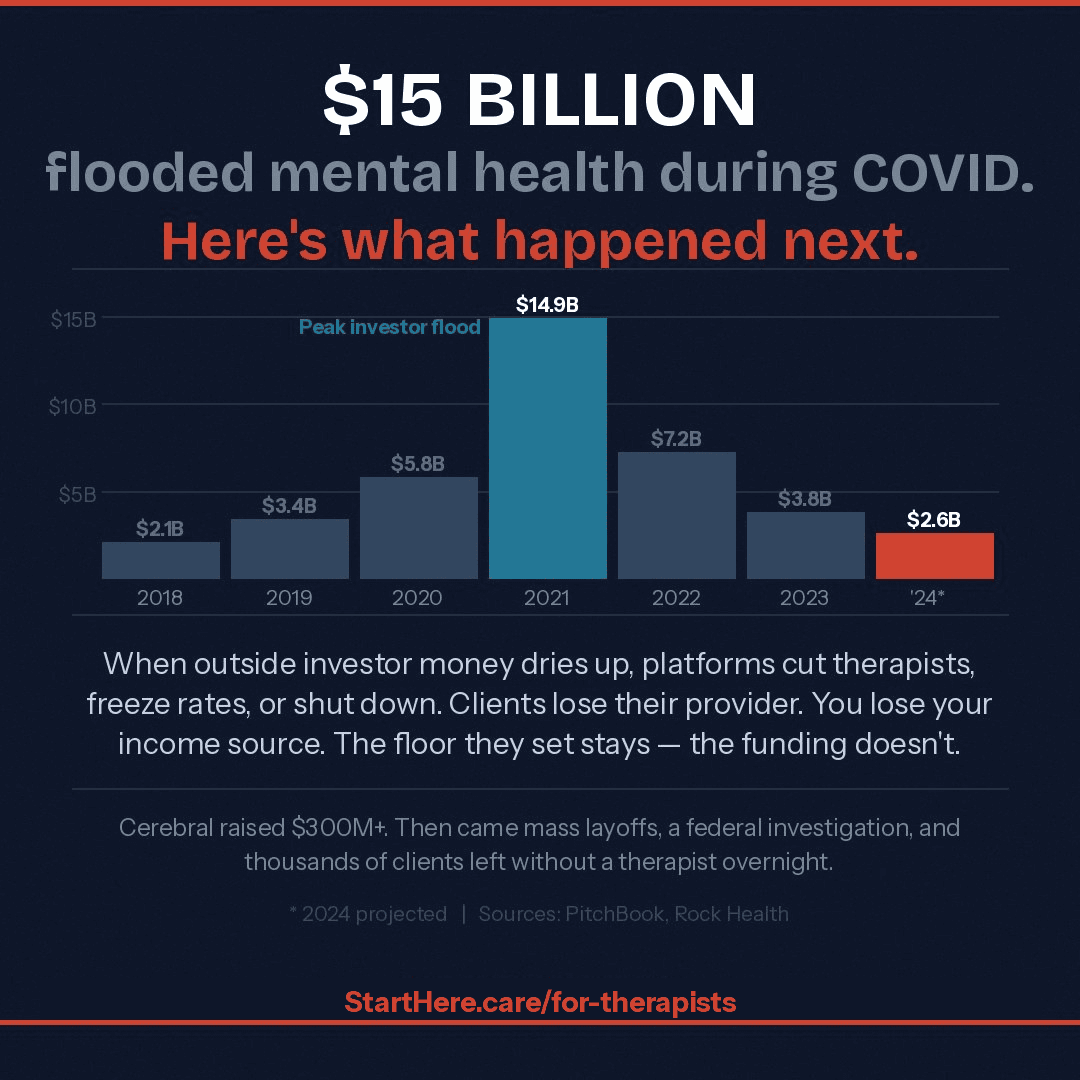
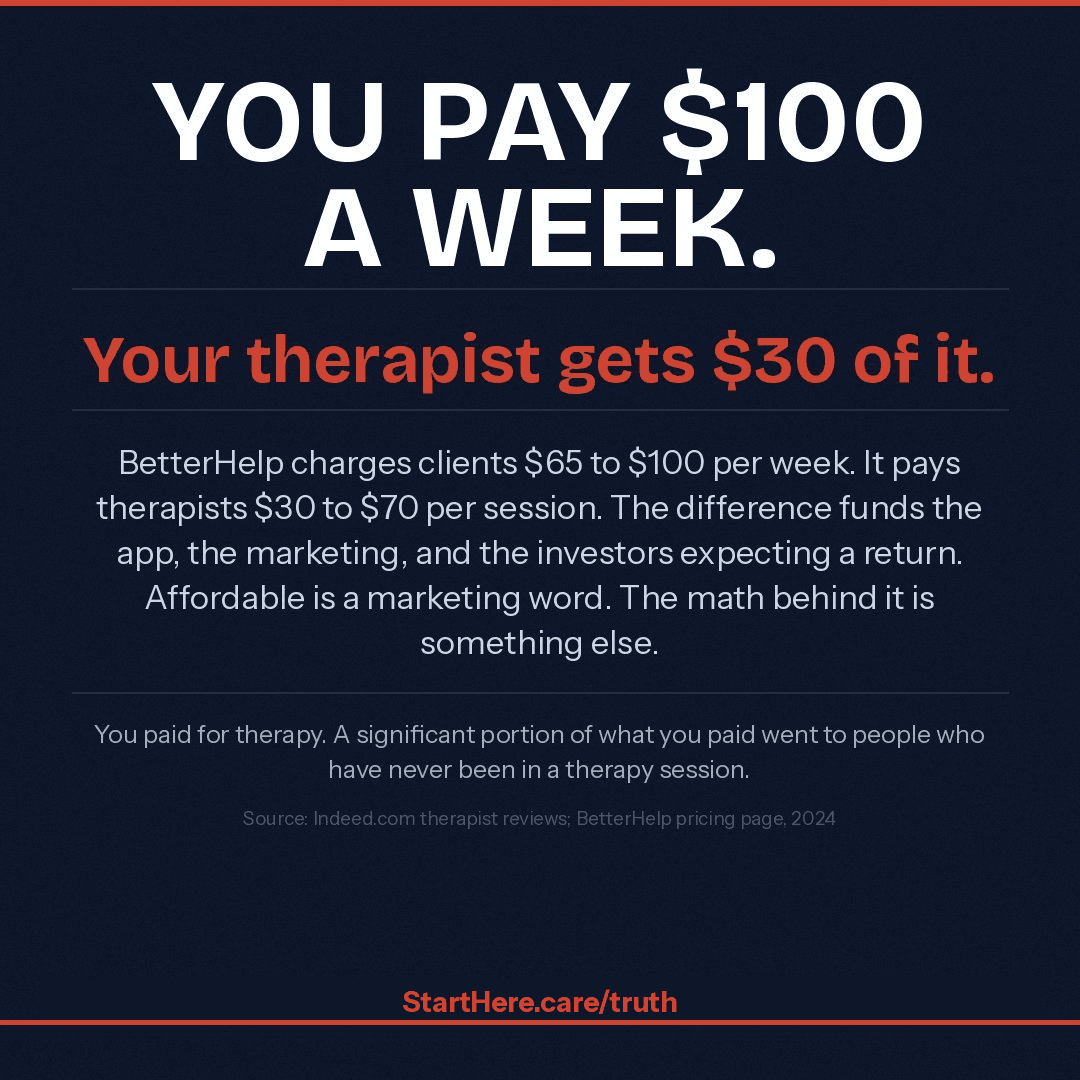
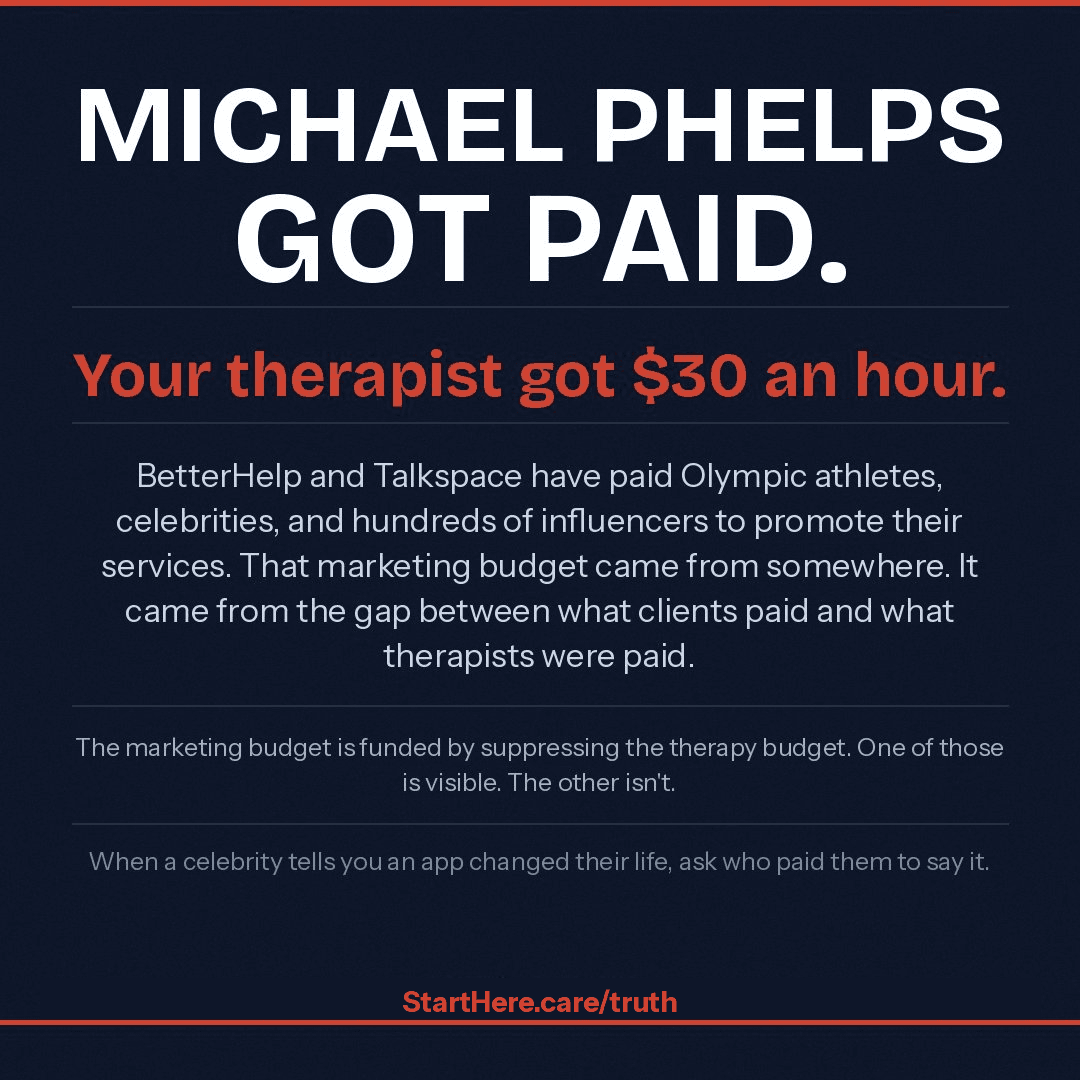
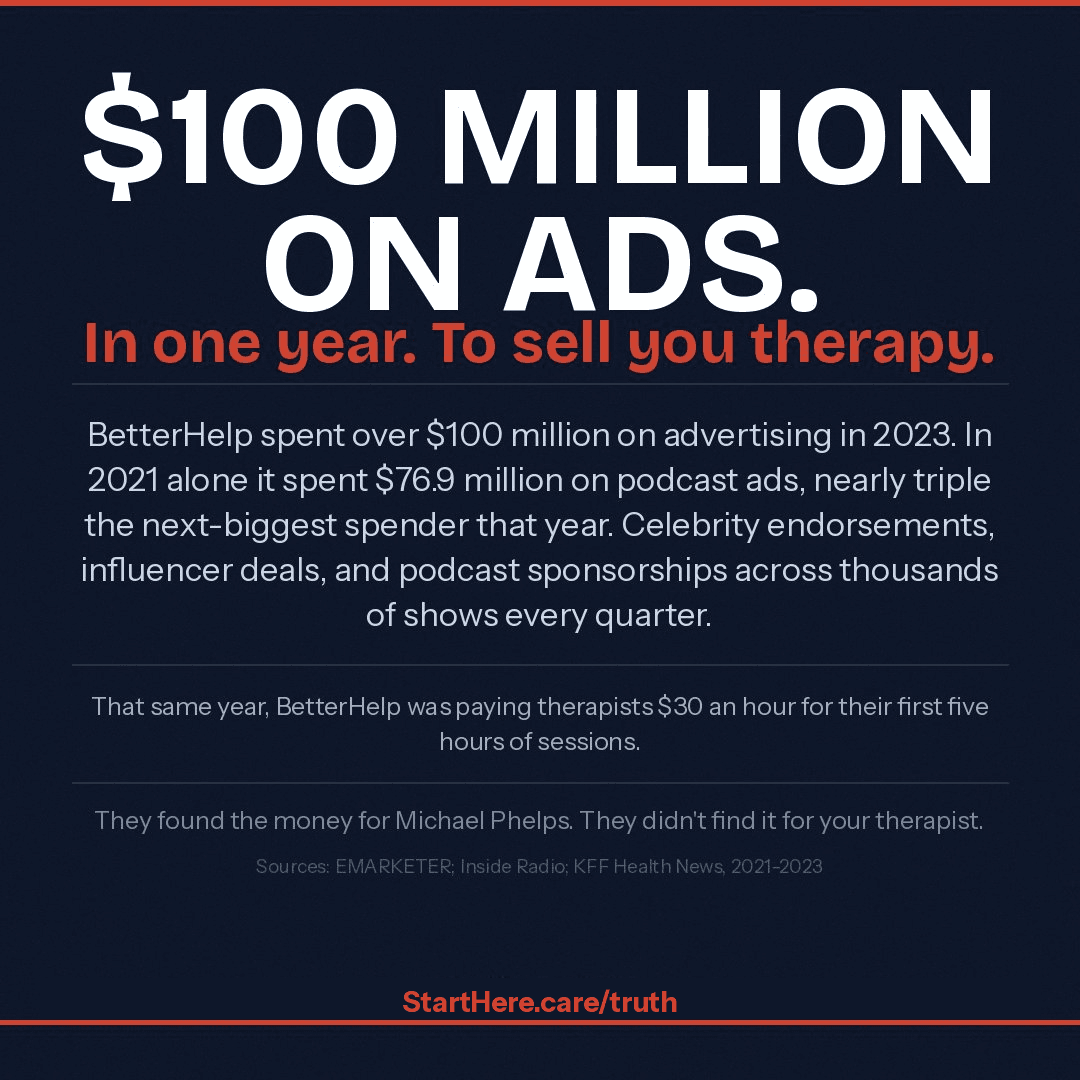
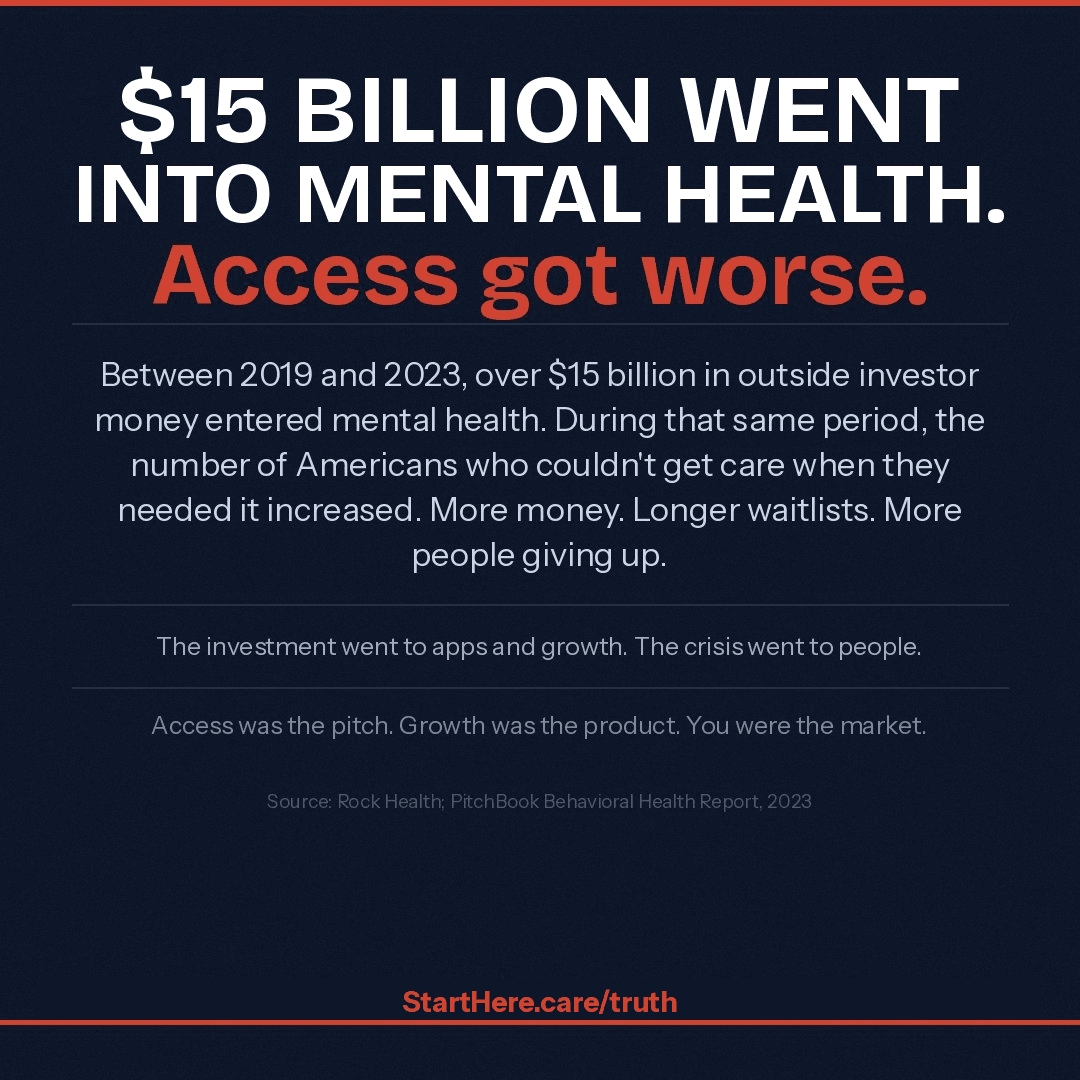
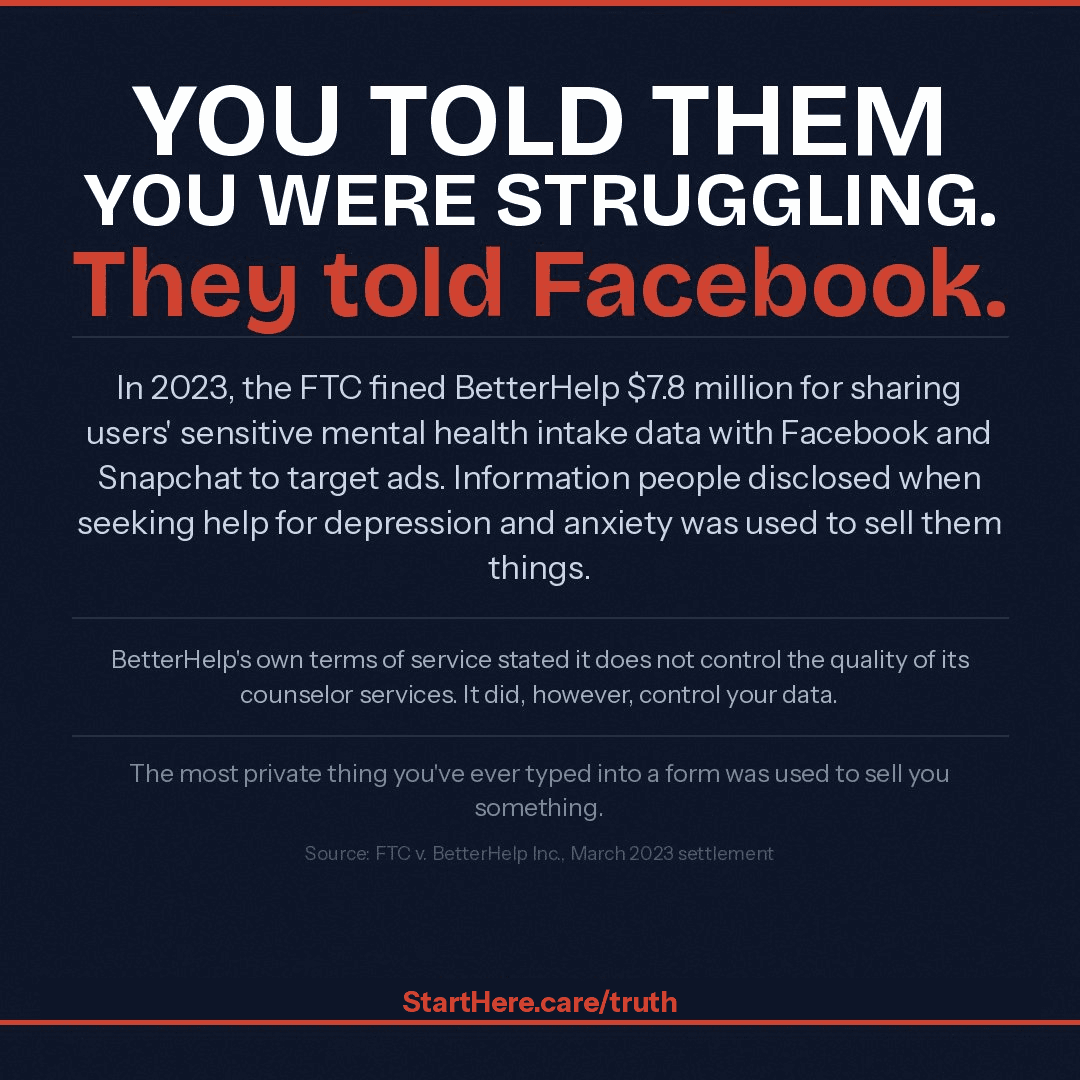
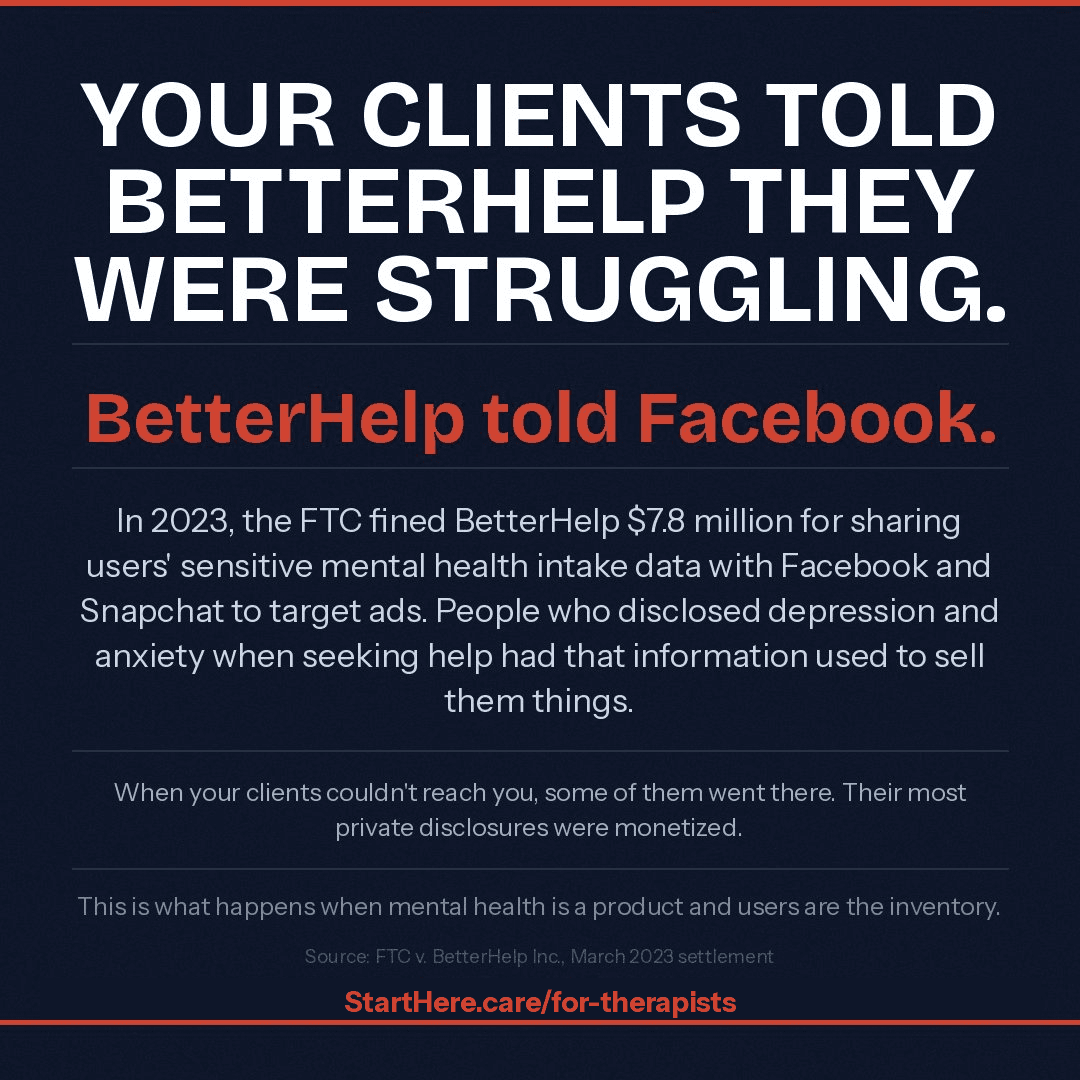
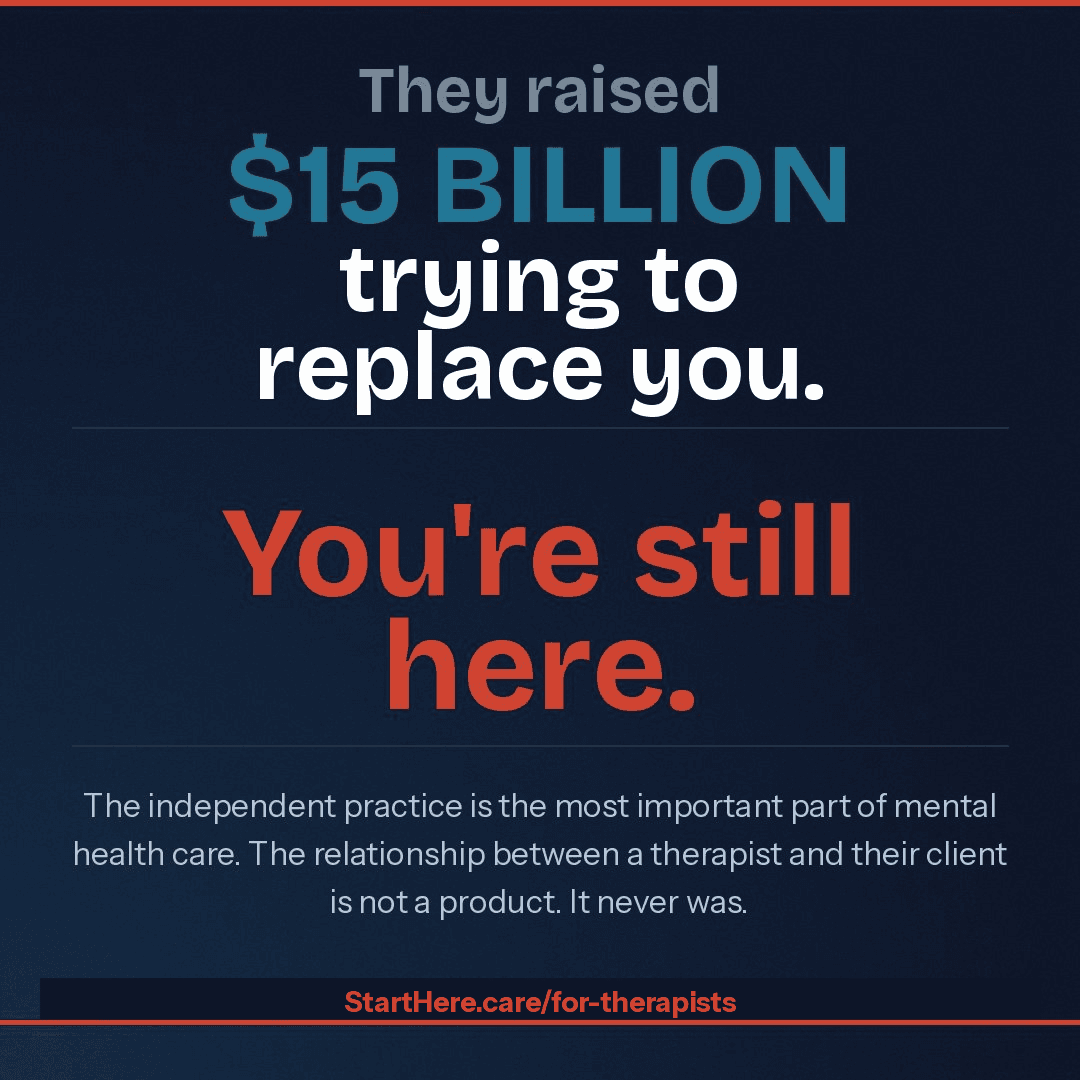
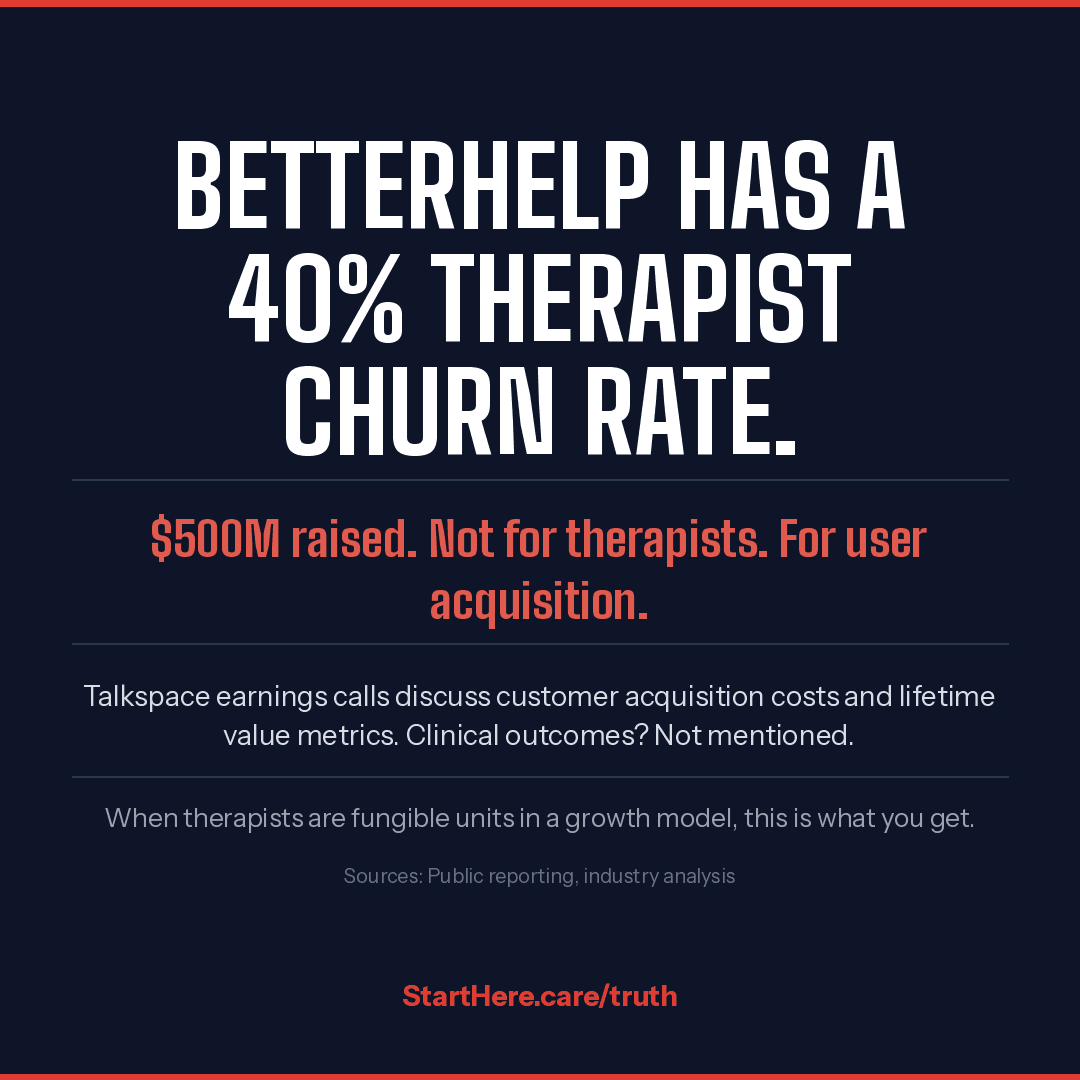
Venture-backed telehealth startups took a different approach. Many entered with a consumer-friendly brand, aggressive subsidized pricing, and growth-at-all-costs strategies funded by VC money, not by sustainable margins. Companies like BetterHelp, Cerebral, and Talkspace raised hundreds of millions of dollars and built enormous user bases quickly. The goal was not necessarily to build a sustainable mental health delivery system. The goal was scale, and then liquidity.
What both models share is a fundamental orientation: mental health is the product, and the financial return is the purpose. The people receiving care are, in the language of their investor decks, the addressable market.
What This Does to Insurance Reimbursement Rates
One of the most direct and damaging effects of for-profit consolidation in mental health is what it does to insurance reimbursement rates, and therefore to provider income and patient access.
The Race to the Bottom on Rates
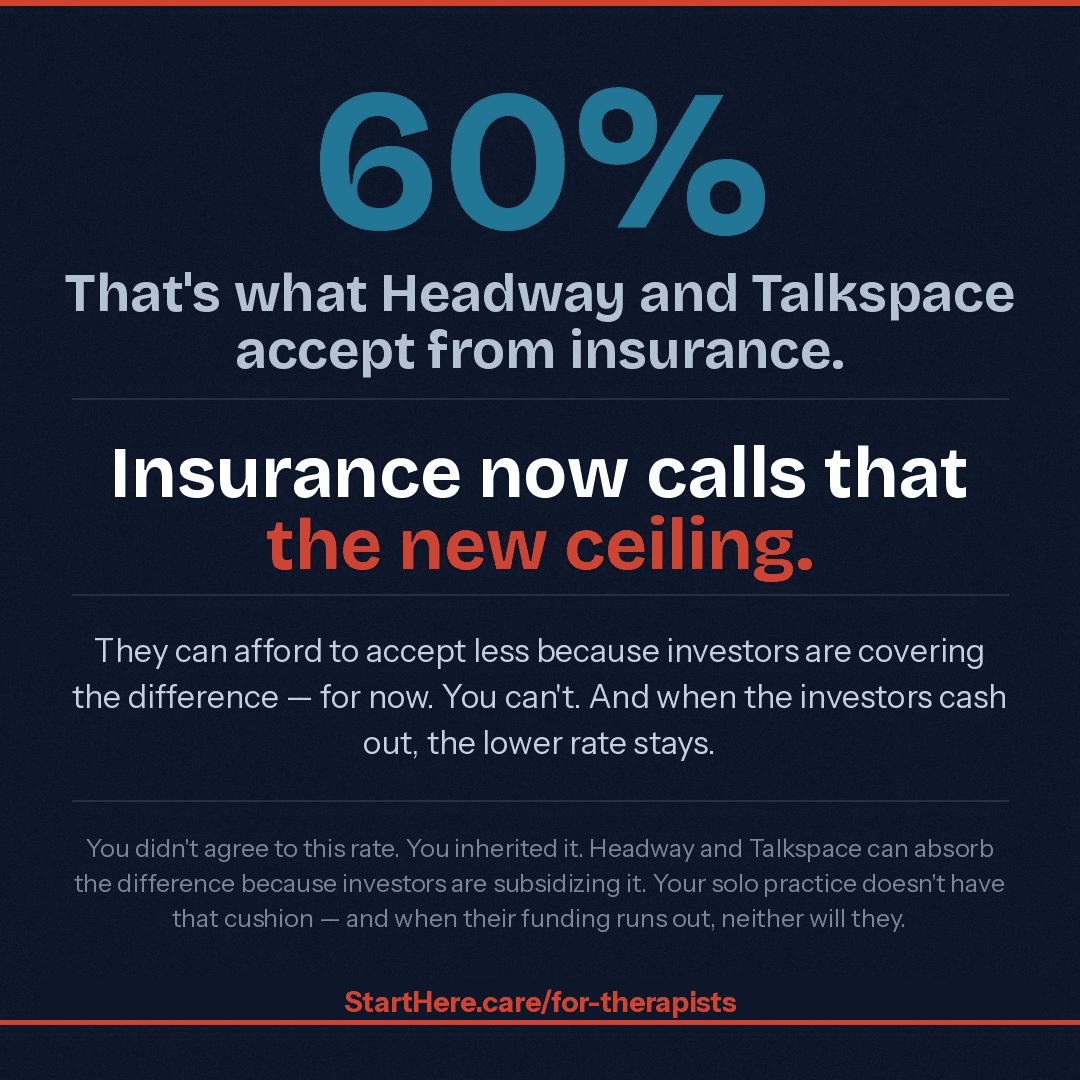
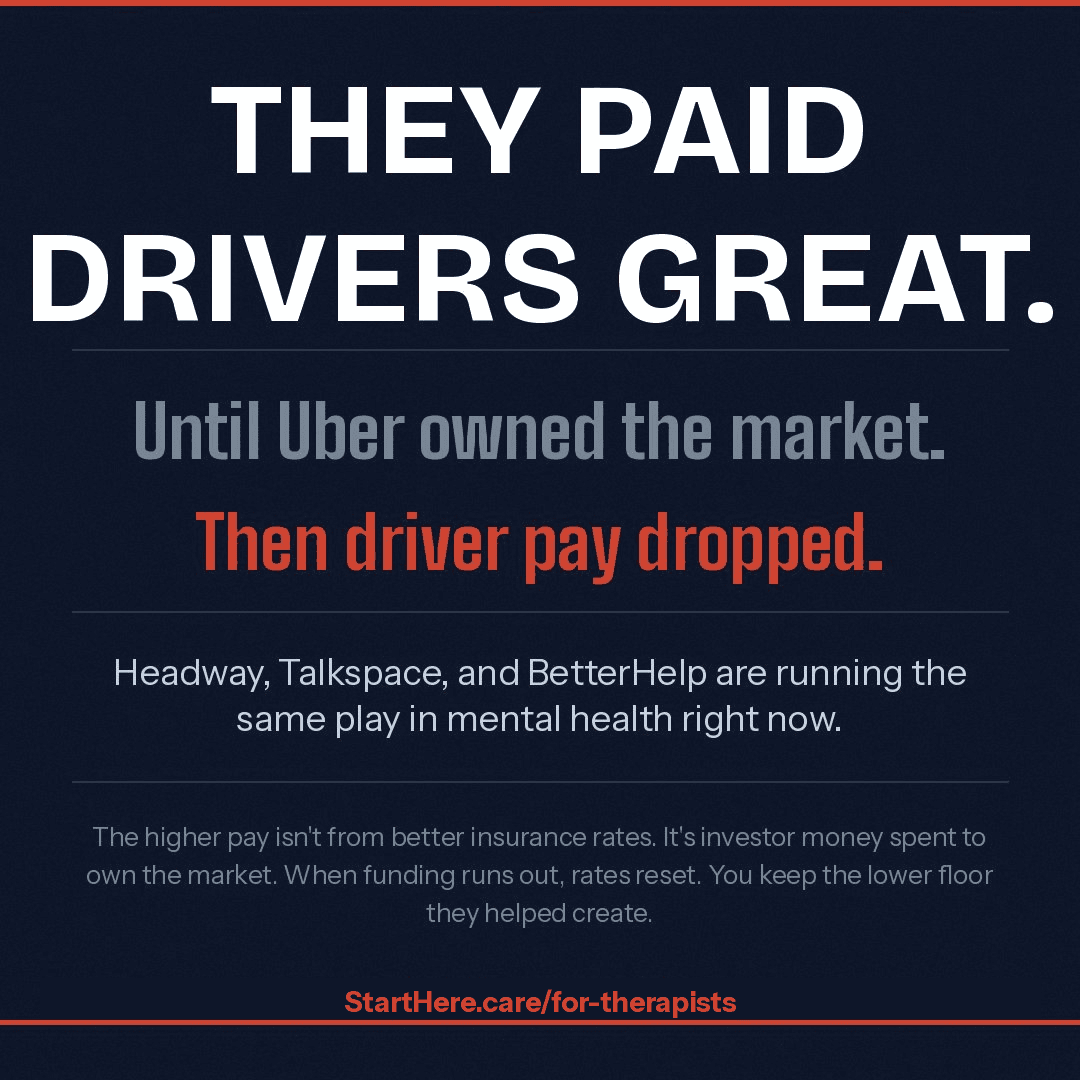
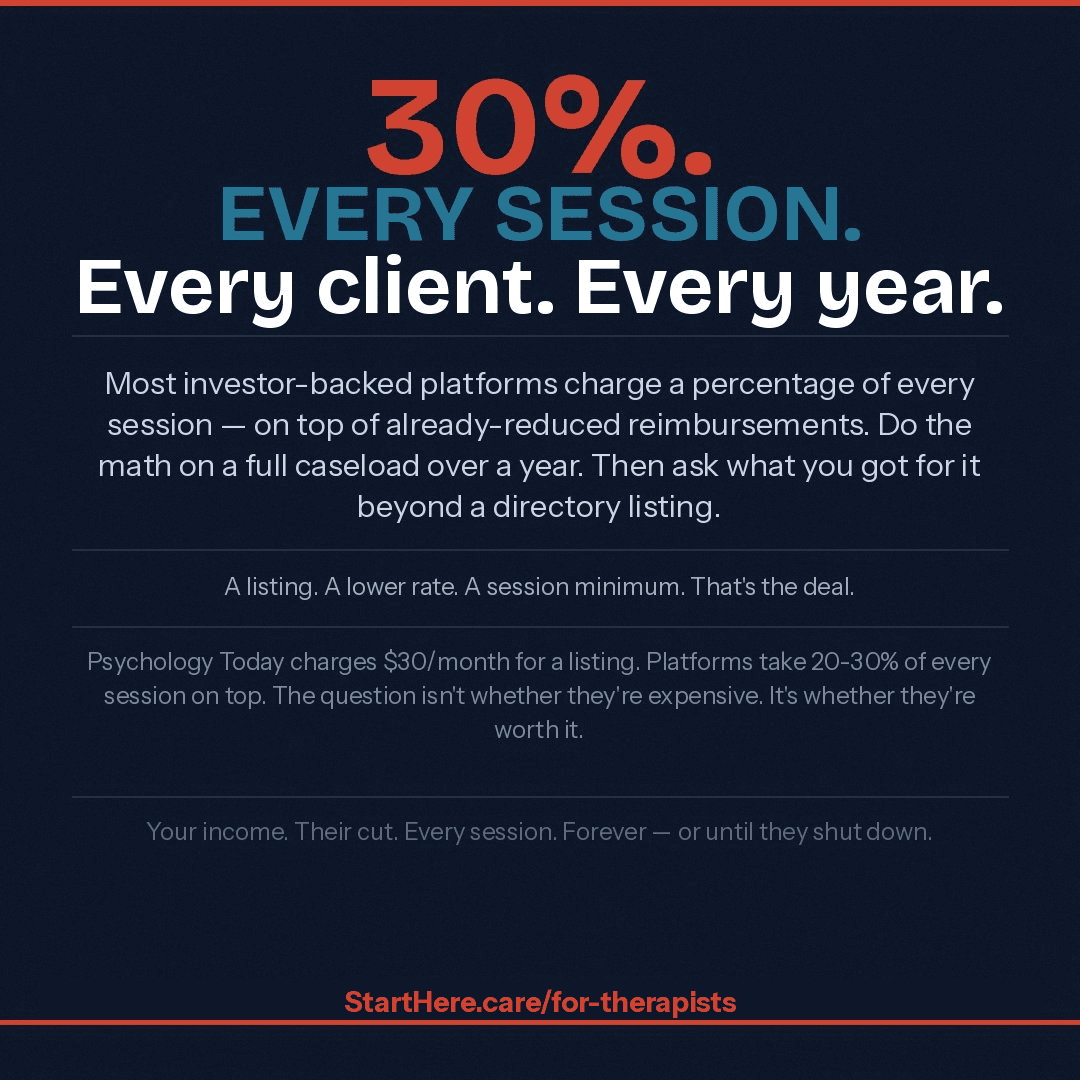
Large consolidated practices and VC-backed telehealth platforms often accept lower insurance reimbursement rates than independent providers would. They can afford to, temporarily, because they are subsidizing losses with investor capital or banking on volume to make margins work. The consequence is that insurance companies, who are always looking to reduce what they pay, use these platforms as leverage to suppress rates across the board.
If a major telehealth network will accept 60 percent of what an independent therapist charges, that becomes the new ceiling for negotiation. Independent providers, who cannot operate at that rate sustainably, face a choice: accept the lower rate, exit insurance networks entirely, or close their practice.
Credentialing Mills and Panel Saturation
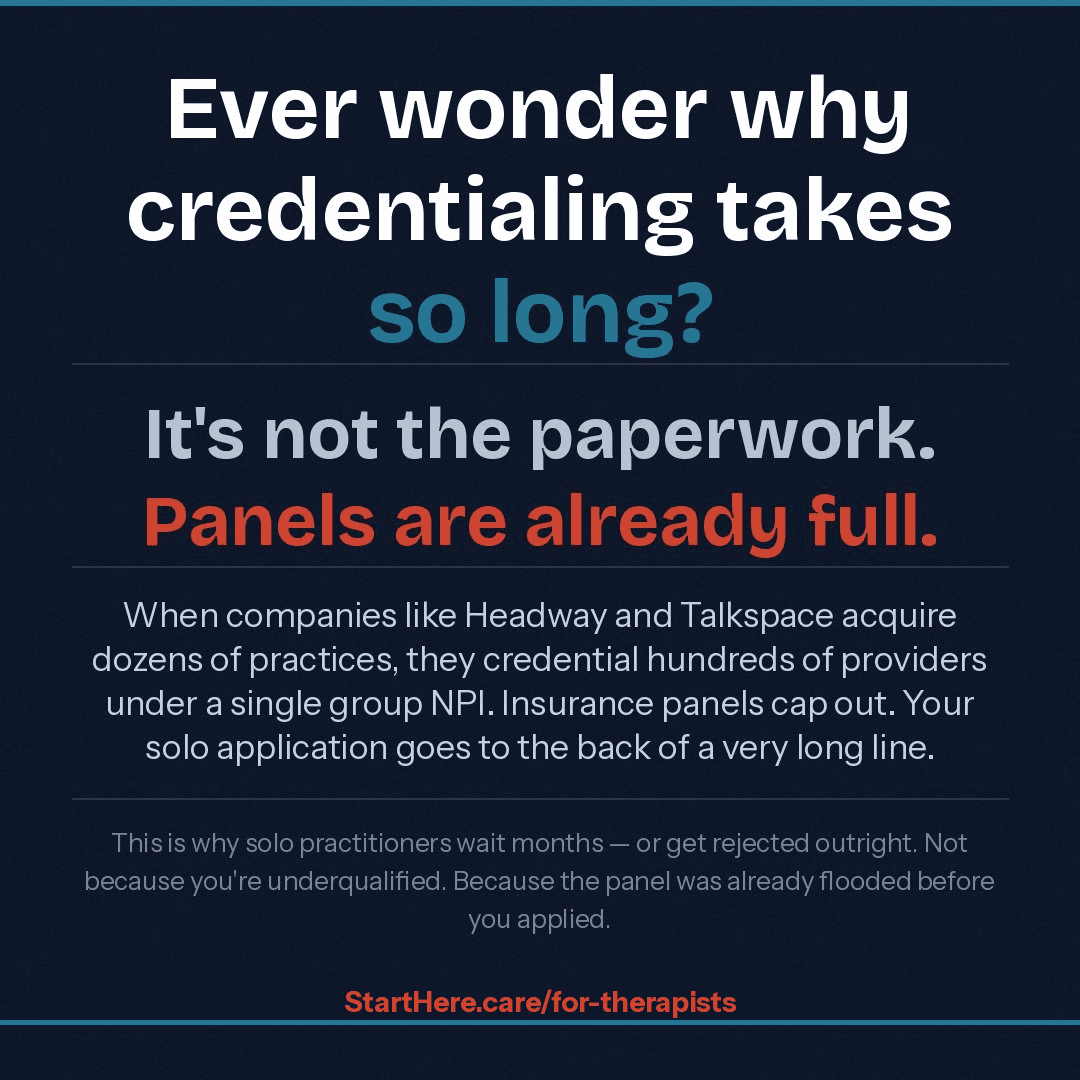
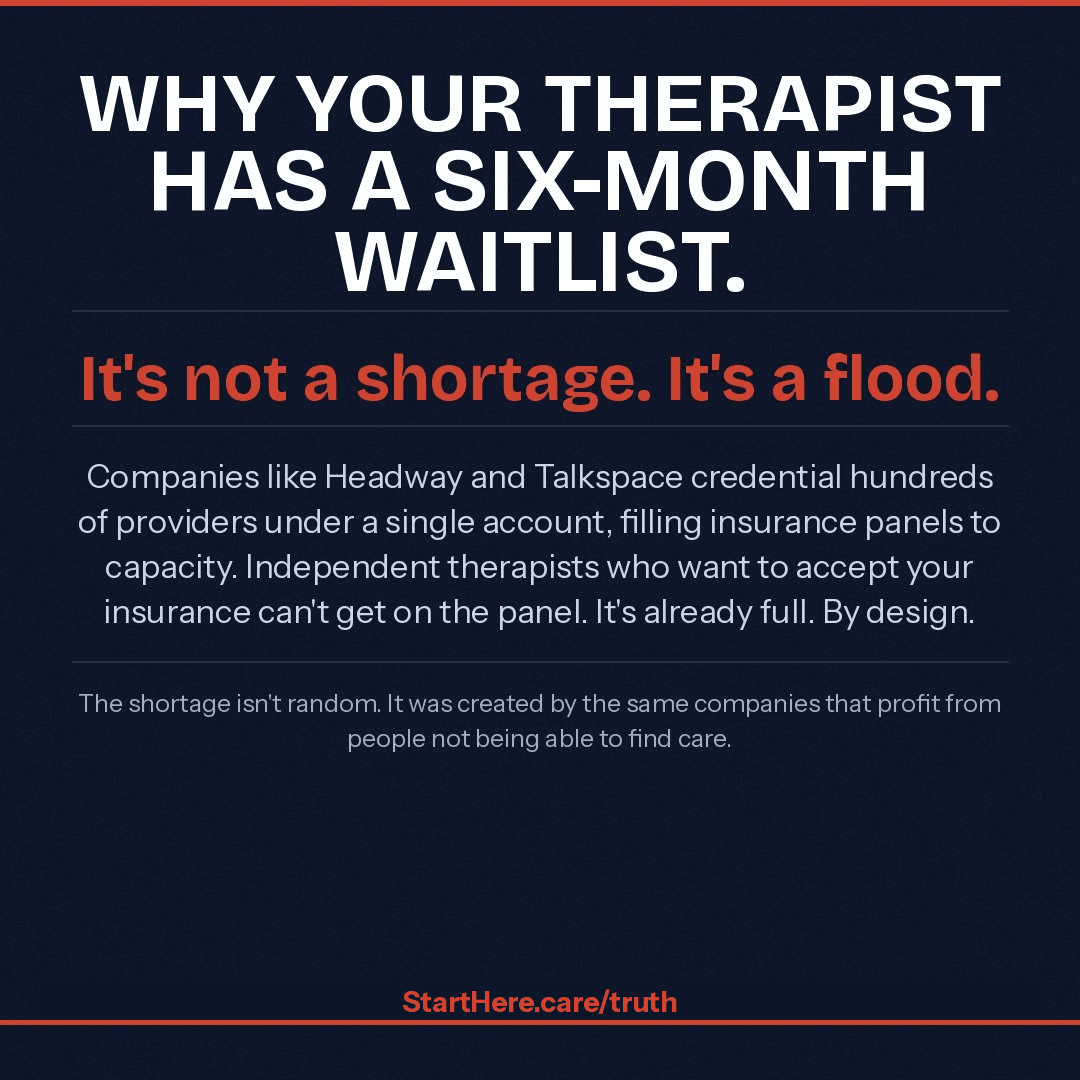
Another pressure point comes from how large platforms handle insurance credentialing. When a holding company acquires dozens of practices, they can credential hundreds of providers under a single group NPI. This can flood insurance panels in ways that make it harder for independent solo practitioners to get paneled at all, locking them out of the insurance system and, effectively, locking out the patients who depend on it.
The net result: consolidation that claims to expand access often concentrates it, and suppresses the income of the independent, community-based providers who serve the most diverse and highest-need populations.
The insurance system was already broken. For-profit consolidation is making it work harder, for investors.


Tired of paying for referrals that don't convert?
StartHere.care sends you clients matched on fit, not zip code. No listing fees. No per-lead charges. No catch.
See How It WorksWhat It Does to Access to Care
The marketing from venture-backed mental health companies often centers on expanding access: reaching people who couldn’t get care before, reducing wait times, lowering costs through technology and scale. Some of that is real. But the full picture is more complicated.
The Short-Term Mirage
In the short term, some of these platforms do expand nominal access. More people can get a therapist appointment more quickly if they have insurance that covers the platform, live in an area with good internet, and can navigate the app. For a slice of the population, this is genuinely meaningful.
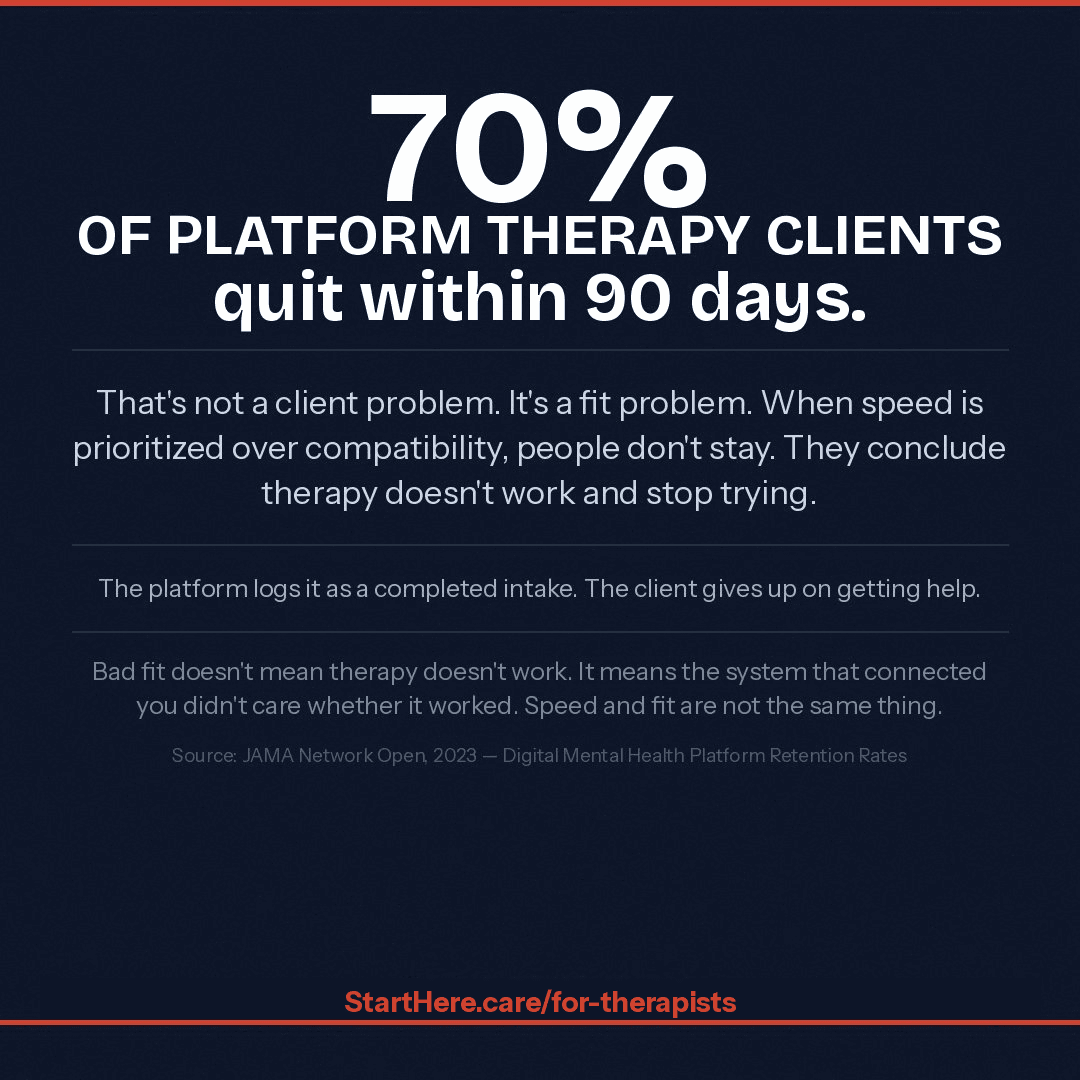
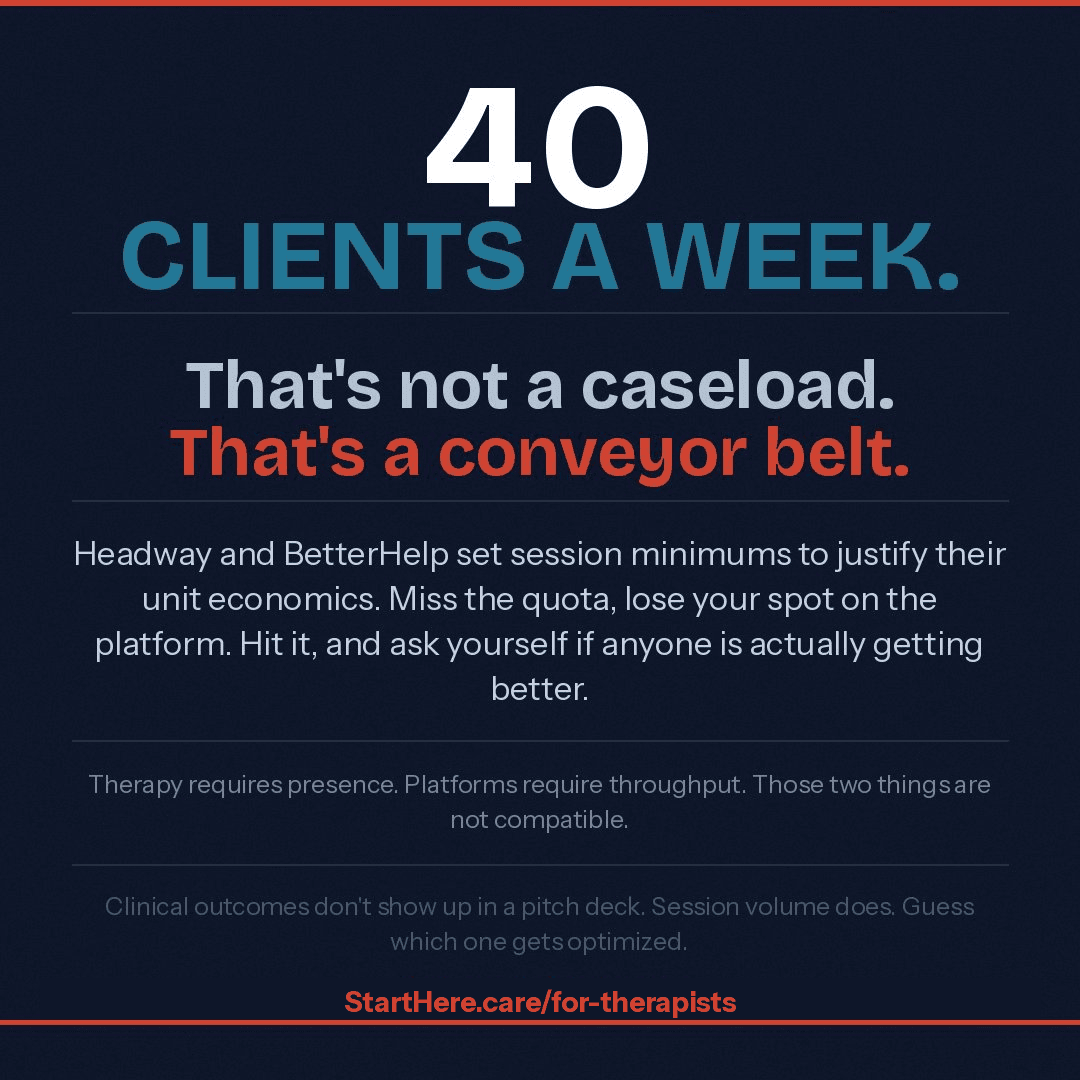
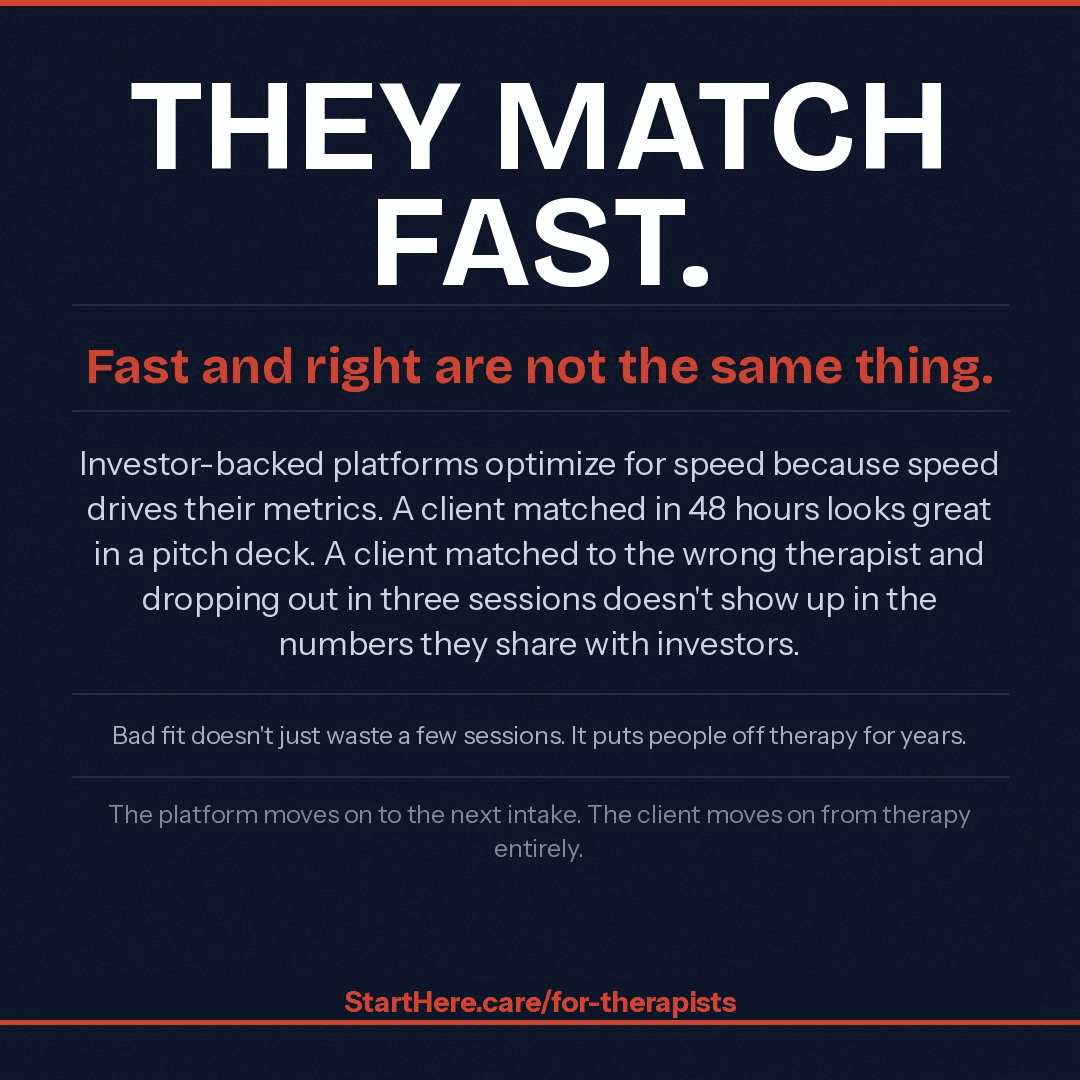
But “access” measured by app downloads or appointment volume is not the same as access measured by clinical outcomes, therapeutic continuity, or fit between client and provider. Many of these platforms have faced documented problems with high therapist turnover, pressure to see unsustainably high session volumes, and match algorithms that prioritize speed over quality of fit.
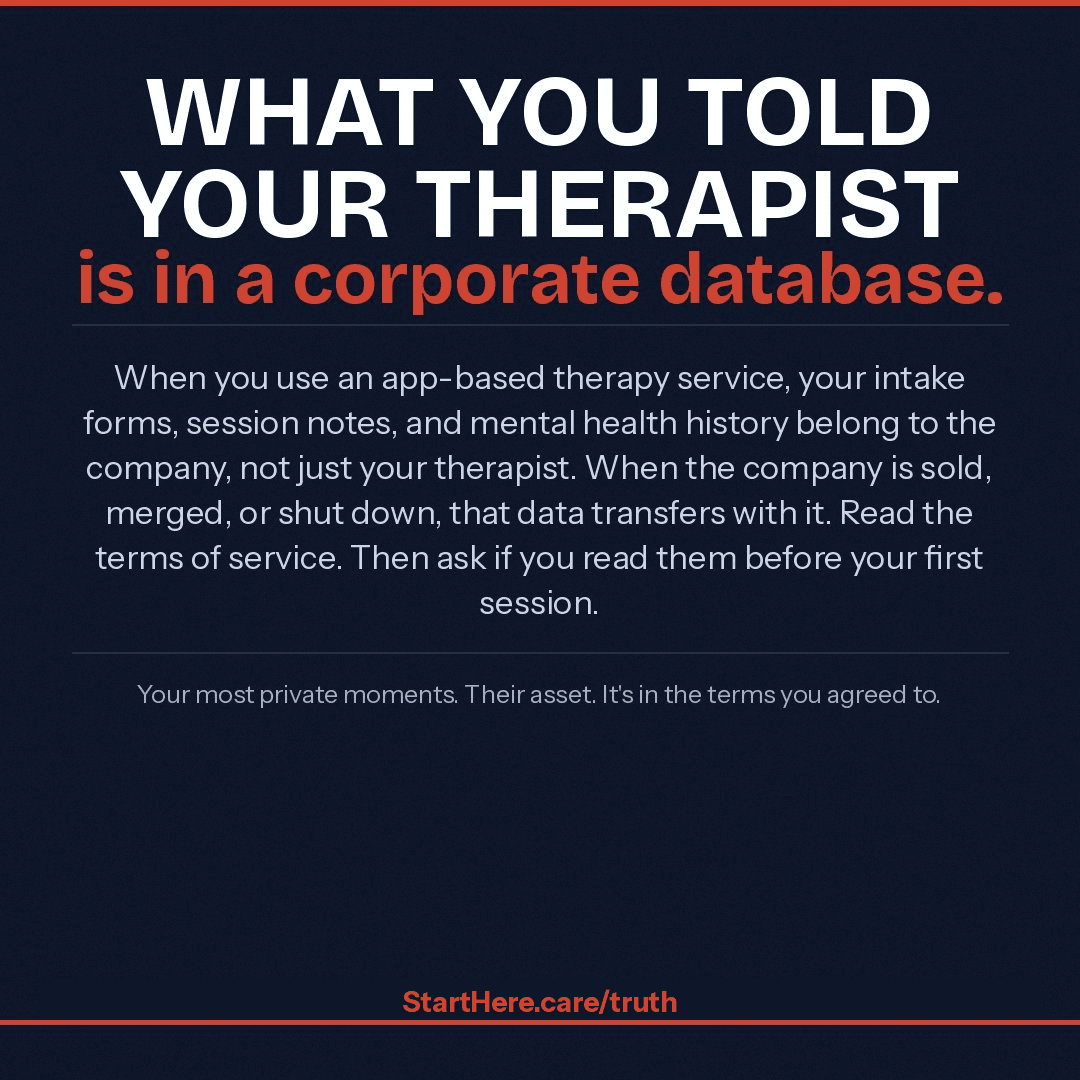
When a therapist is seeing 30 or 40 clients a week to meet a platform’s quota, the quality of care for each client goes down. That is not expanded access. That is expanded exposure with diluted quality.
The Communities Left Behind
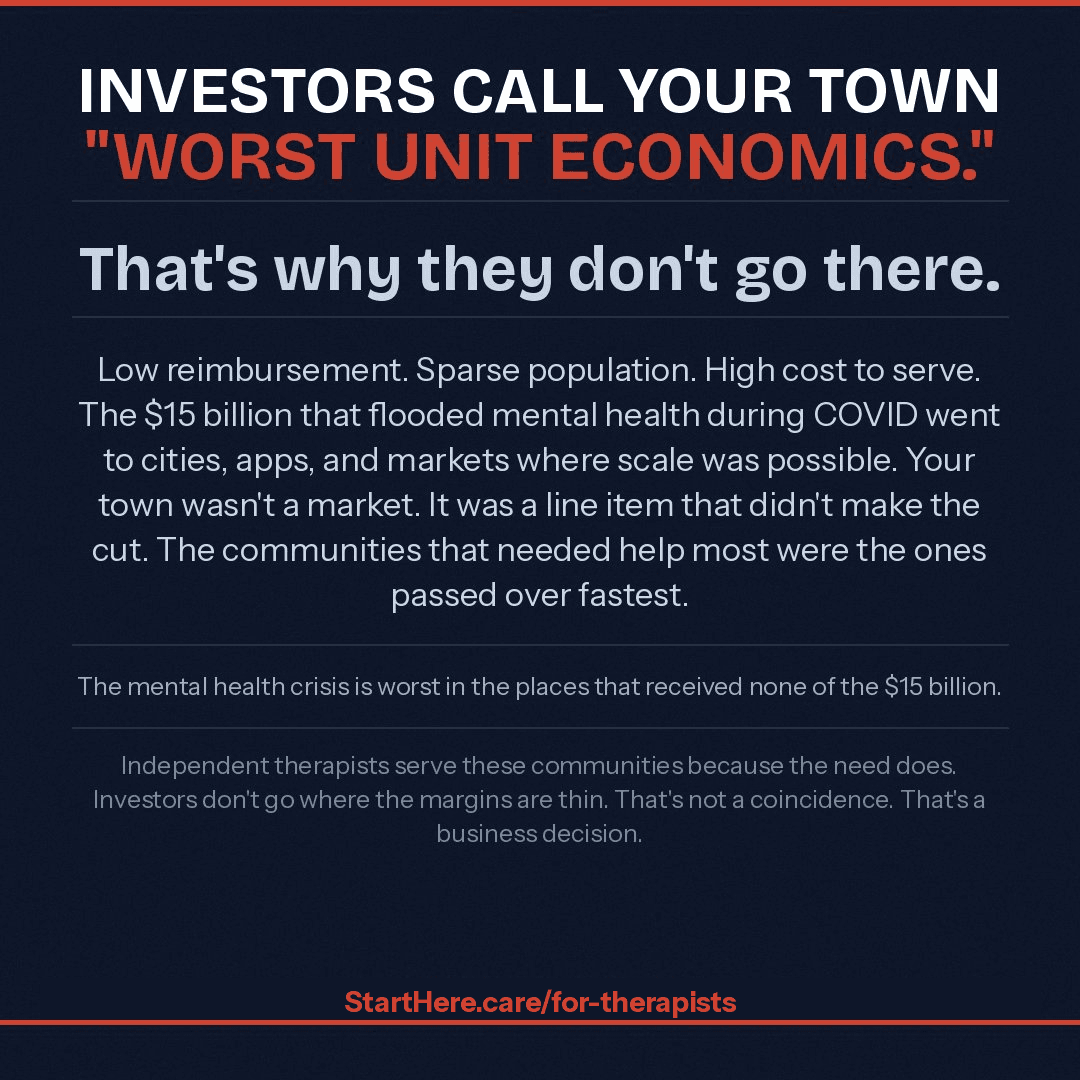
For-profit mental health investment follows the money, which means it follows insured, urban, and higher-income populations. The rural communities, the uninsured, the Medicaid-dependent, the populations with the most severe and complex needs: these are the markets that generate the worst unit economics, and they are being systematically underserved by investor-driven healthcare.
Community mental health centers and federally qualified health centers, which have historically filled the gap for these populations, are not acquisition targets. They are struggling to compete for the workforce that VC-backed platforms are recruiting away with higher pay and better-branded working conditions.

The Short-Term Outlook: A Turbulent Shakeout
The next few years in the for-profit mental health space are going to be rocky, and not for reasons that benefit patients.
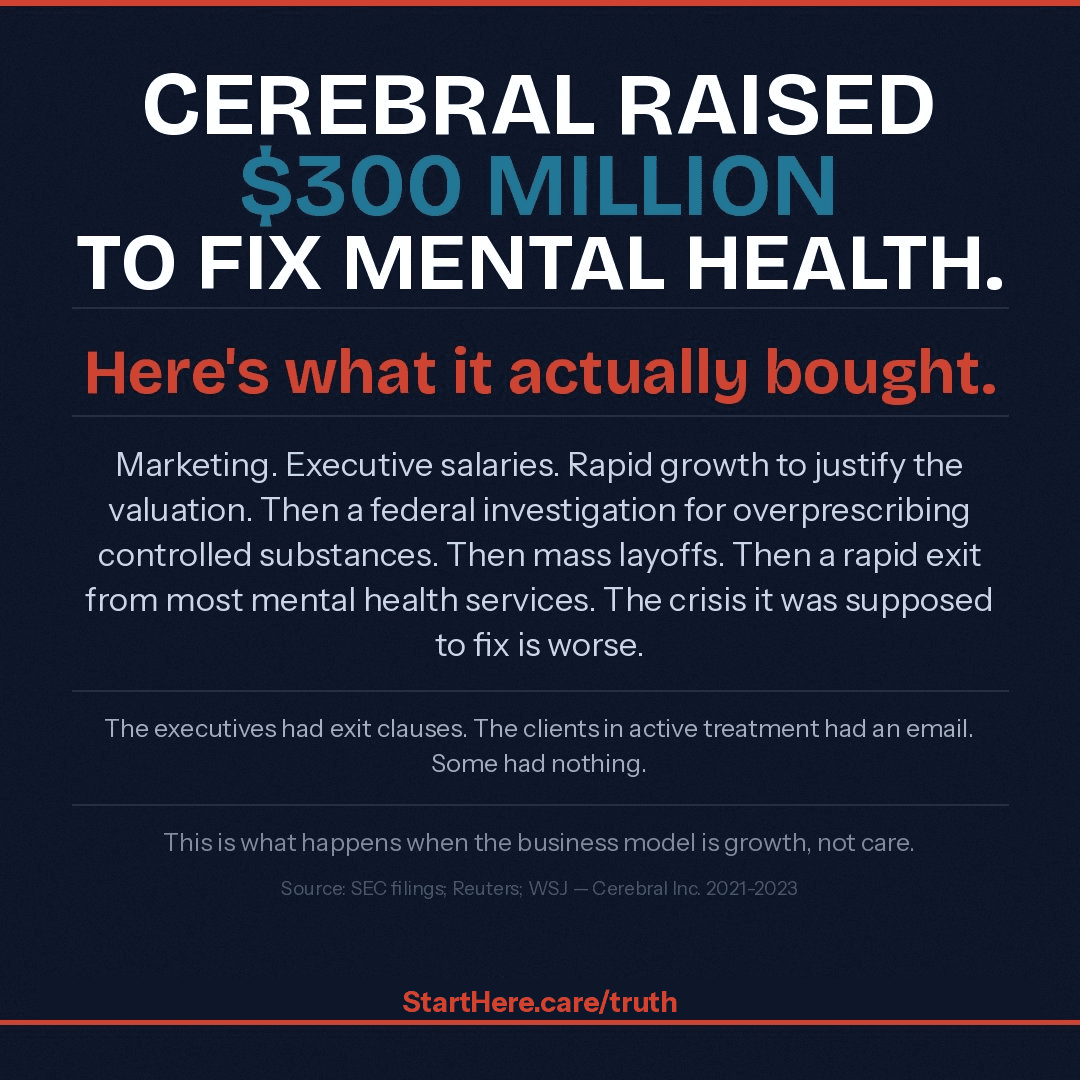
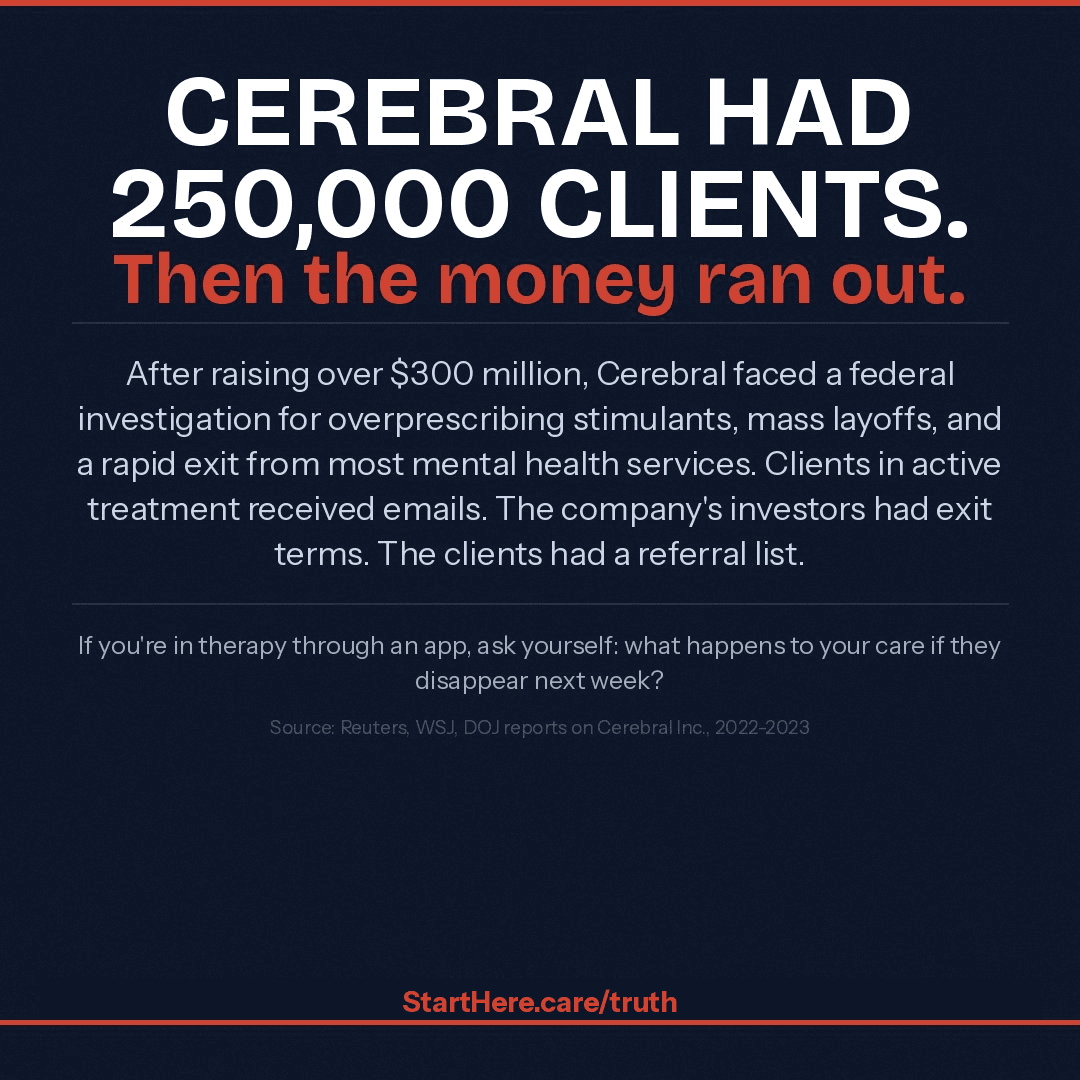
Many of the VC-backed telehealth platforms that grew aggressively during the pandemic are now facing the reckoning that comes when growth capital dries up and profitability is required. Cerebral, which raised more than $300 million, faced federal investigations, leadership turnover, and significant layoffs. Others are consolidating, pivoting, or quietly shutting down programs.
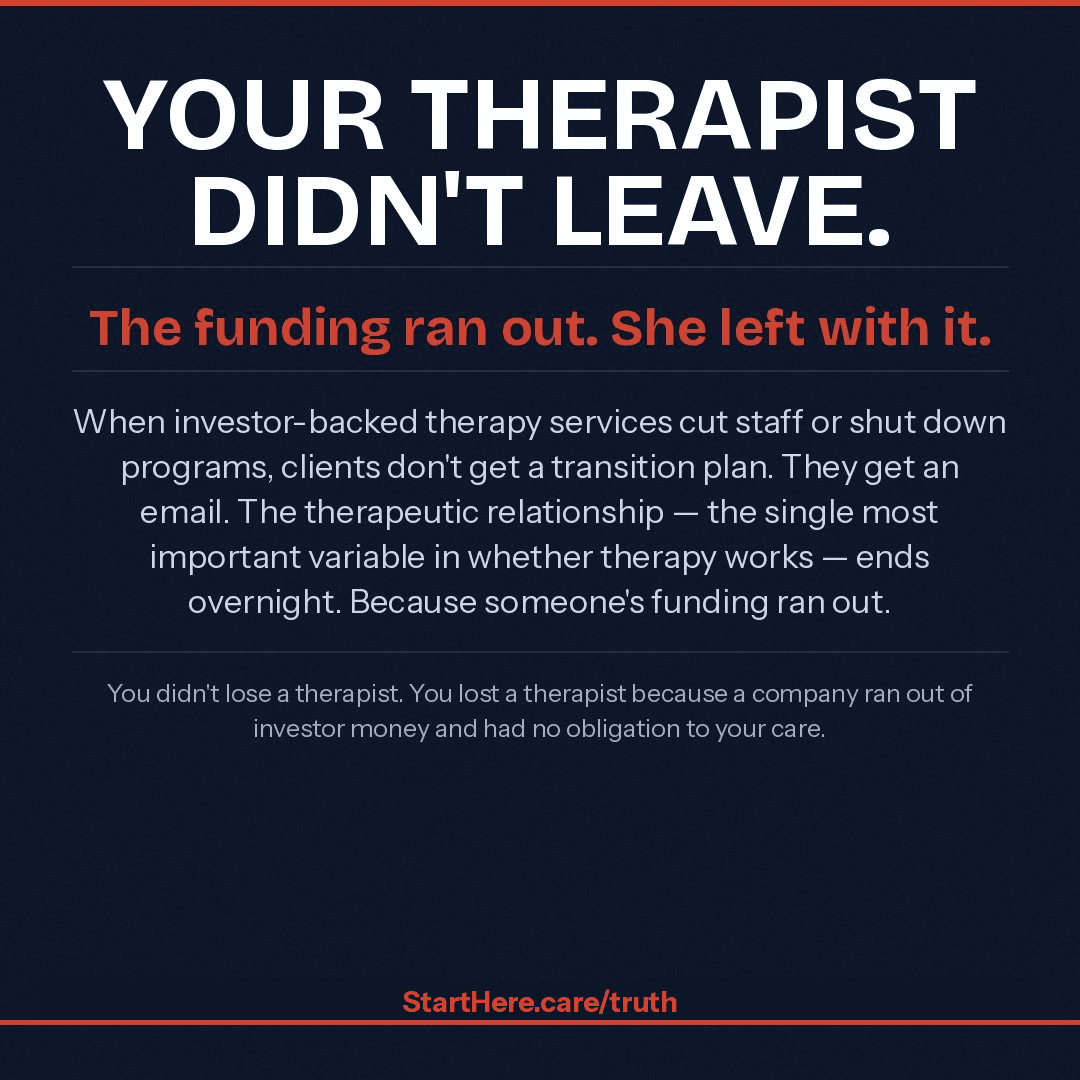
When these platforms fail or contract, the clients who built therapeutic relationships through them are left scrambling. Therapists who built their practice inside a platform are left without their patient base. The communities that came to depend on these services are left with less than they had before, and sometimes with no transition support at all.
Private equity acquisitions are similarly creating instability. As holding companies manage debt loads from acquisitions, pressure to hit financial targets falls on the practices and the providers within them. Burnout accelerates. Turnover increases. Clinical quality degrades. And when those practices become unprofitable or the holding company needs liquidity, they are sold again, restructured, or closed, with little regard for continuity of care.
The Long-Term Risk: Structural Damage That Outlasts the Hype
The longer-term consequences are more troubling than the short-term volatility, because they are harder to reverse.
Workforce Demoralization and Exodus
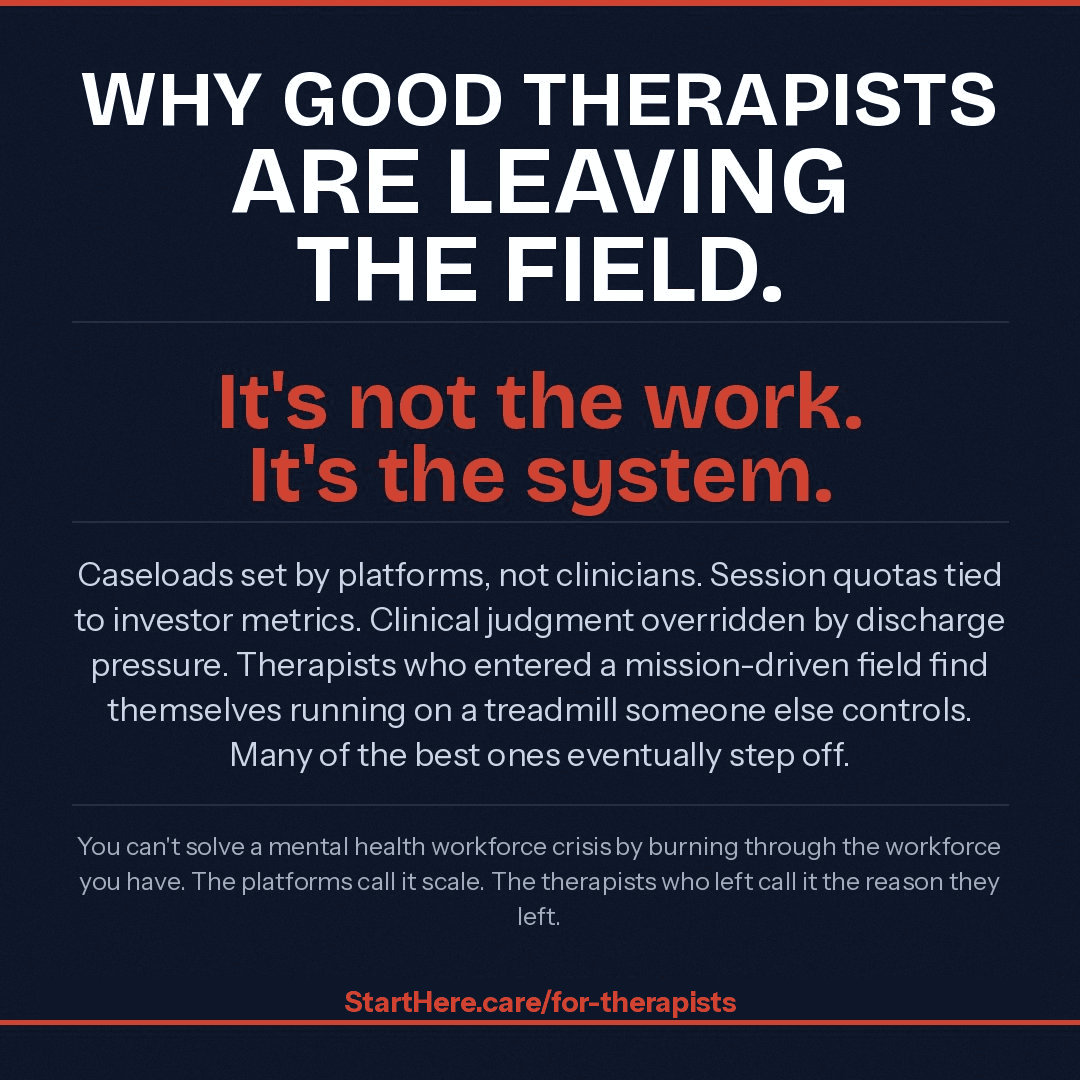
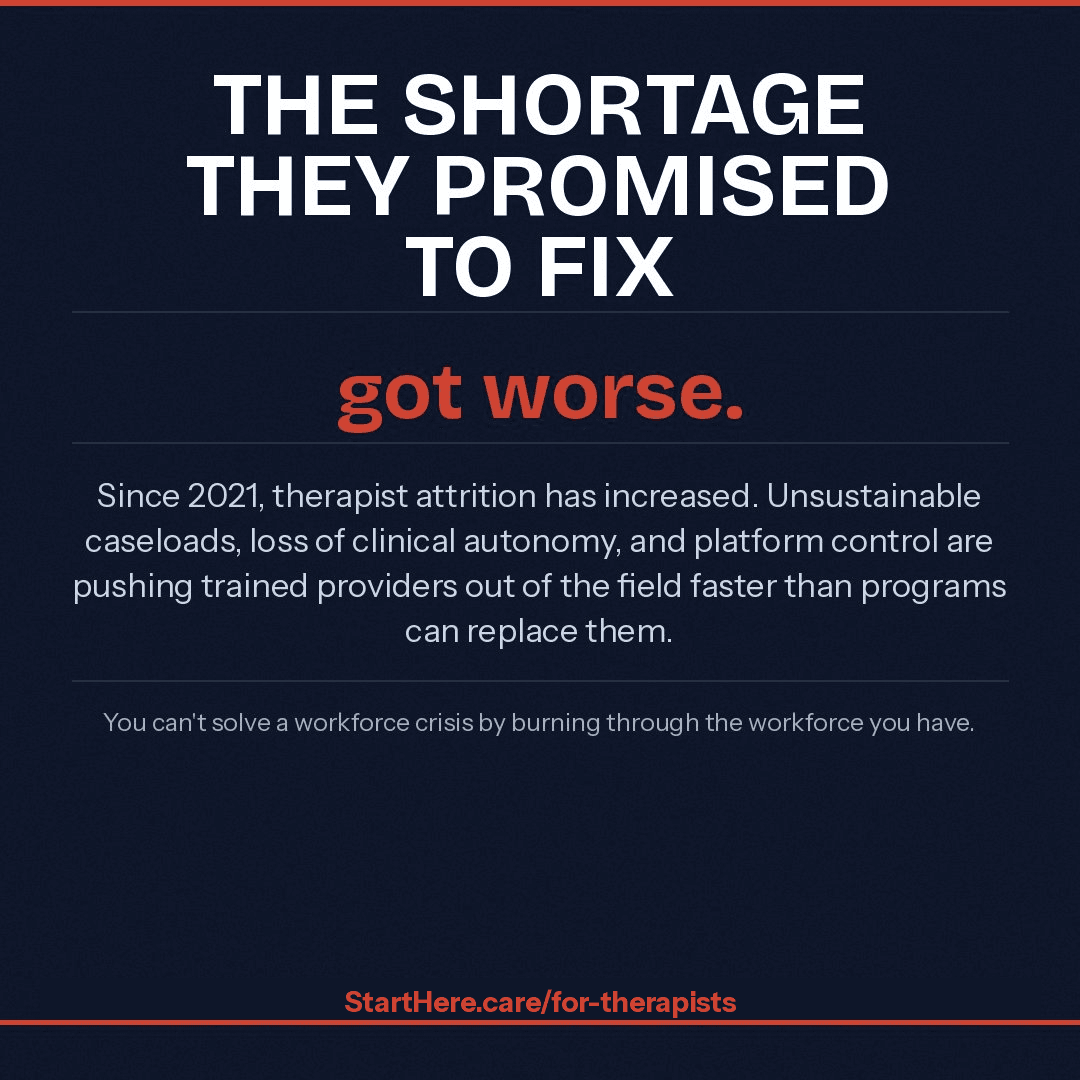
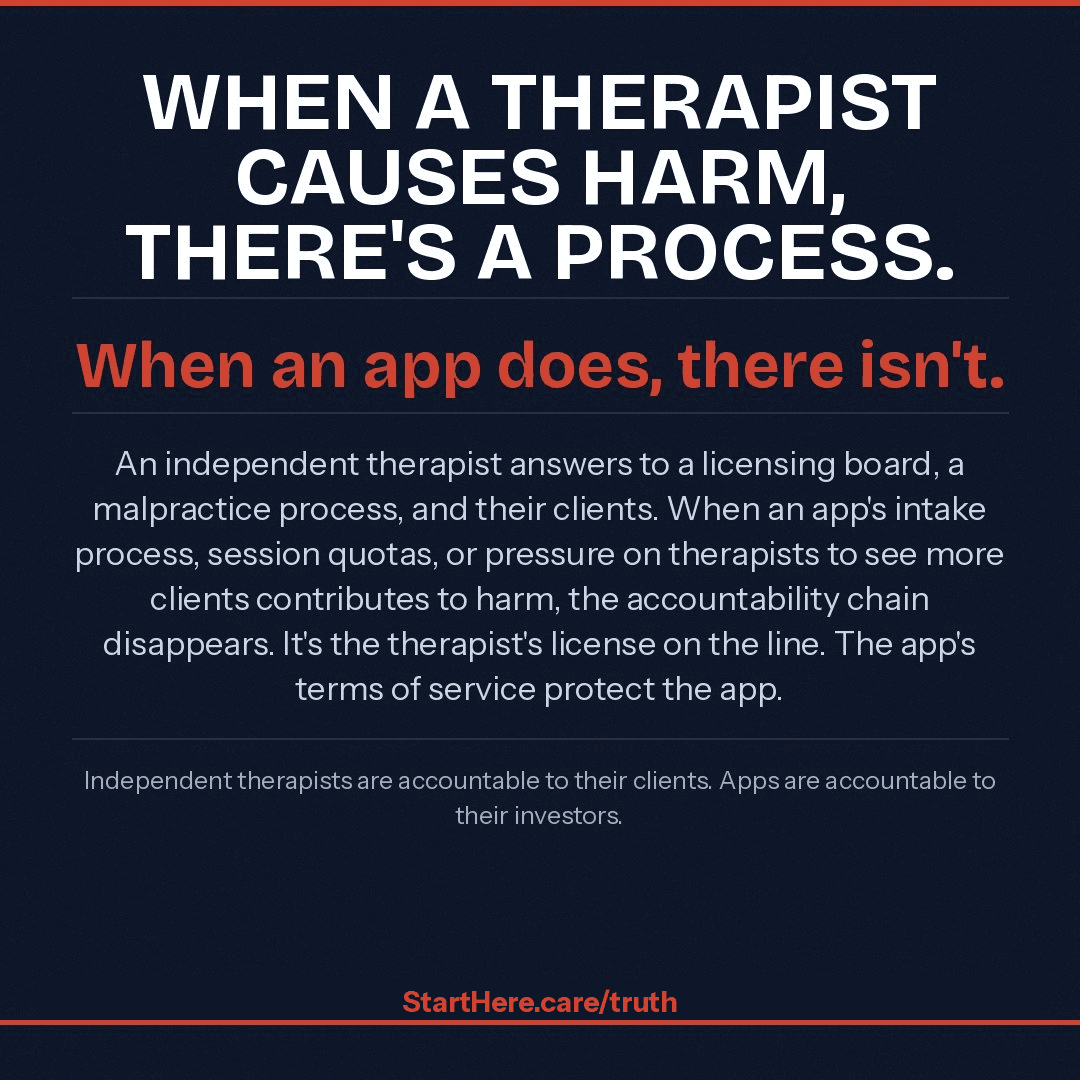
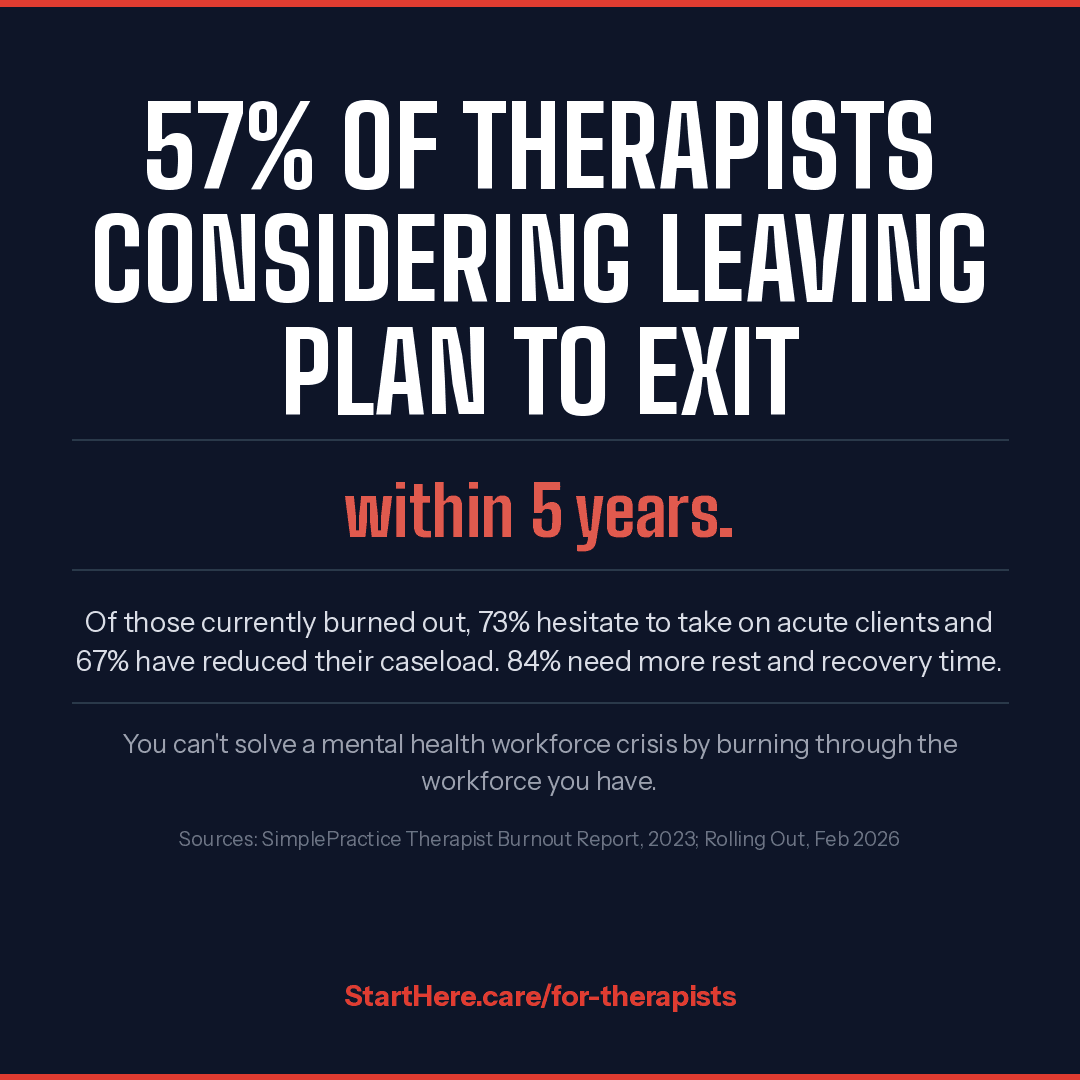
Mental health providers entered their professions with a mission orientation. They accepted lower pay than their graduate school debt suggested they should accept because the work felt meaningful and autonomous. When their practices are acquired, their caseloads are dictated by algorithms, their documentation is automated and monitored for productivity, and their clinical judgment is overridden by platform policies, many of them leave.
The pipeline into the profession also suffers. When word spreads through graduate programs that the job market is increasingly dominated by for-profit platforms with poor working conditions, fewer people pursue the field. The workforce shortage that investors claimed to be solving becomes worse over time.
Suppressed Reimbursement as a Permanent Baseline
Reimbursement rates that are suppressed during a period of investor-subsidized competition tend to become locked in as permanent baselines when the competition recedes. Insurance companies do not voluntarily raise rates. Once the floor drops, it becomes the floor. Independent providers and community-based practices will spend years trying to negotiate their way back to sustainable rates, and many will not succeed.
Erosion of the Independent Practice Model
Perhaps the most consequential long-term effect is the gradual erosion of the independent practice model in mental health. Independent therapists and small group practices represent the most flexible, community-rooted, therapeutically diverse part of the mental health system. They serve the full range of presenting concerns. They build long-term relationships. They adapt to their communities.
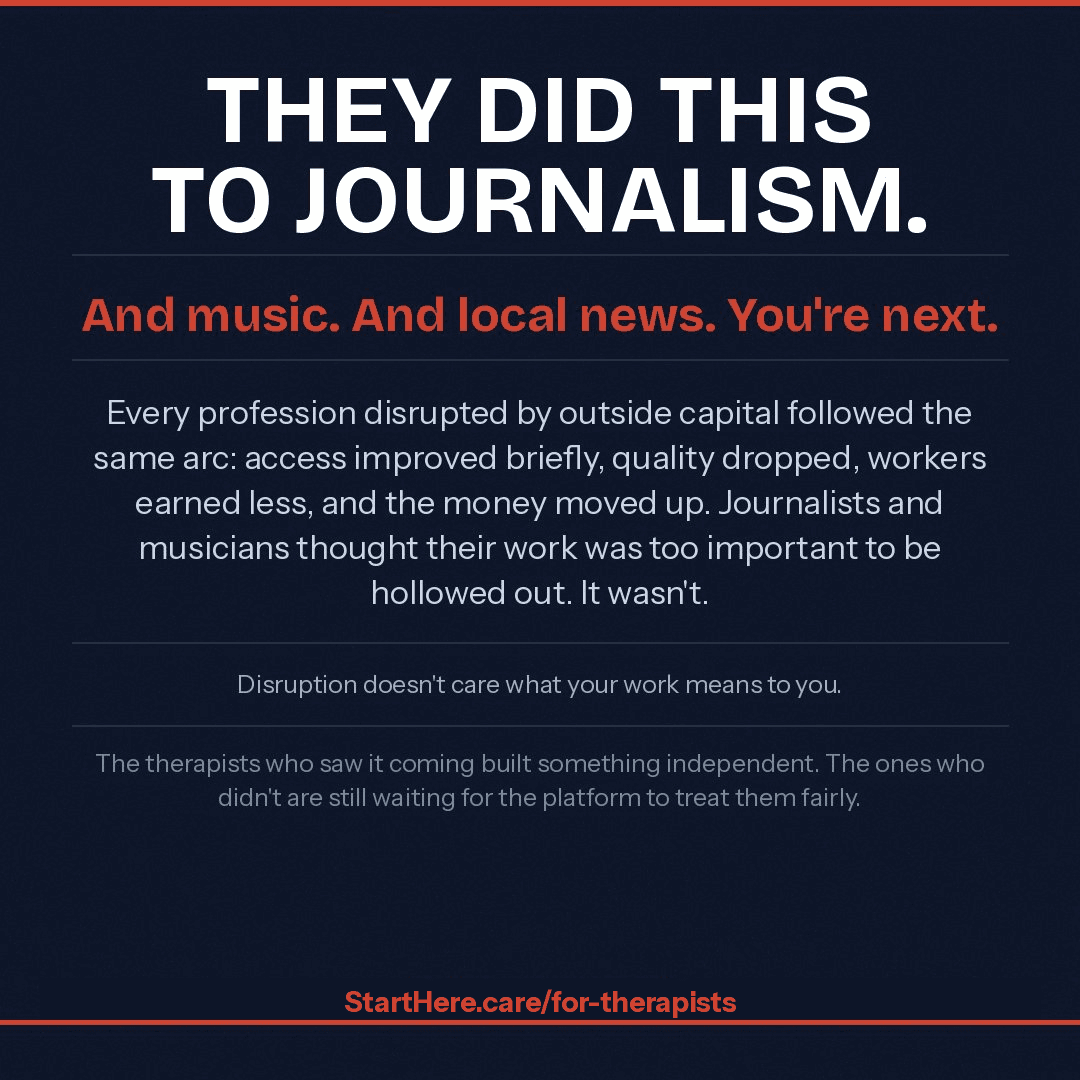
As the economics of independent practice become harder, due to suppressed rates, panel exclusion, and competition for clients from subsidized platforms, fewer therapists will attempt to build independent practices. The field will increasingly concentrate in corporate structures that optimize for throughput, not for the kind of relational, longitudinal care that mental health actually requires.
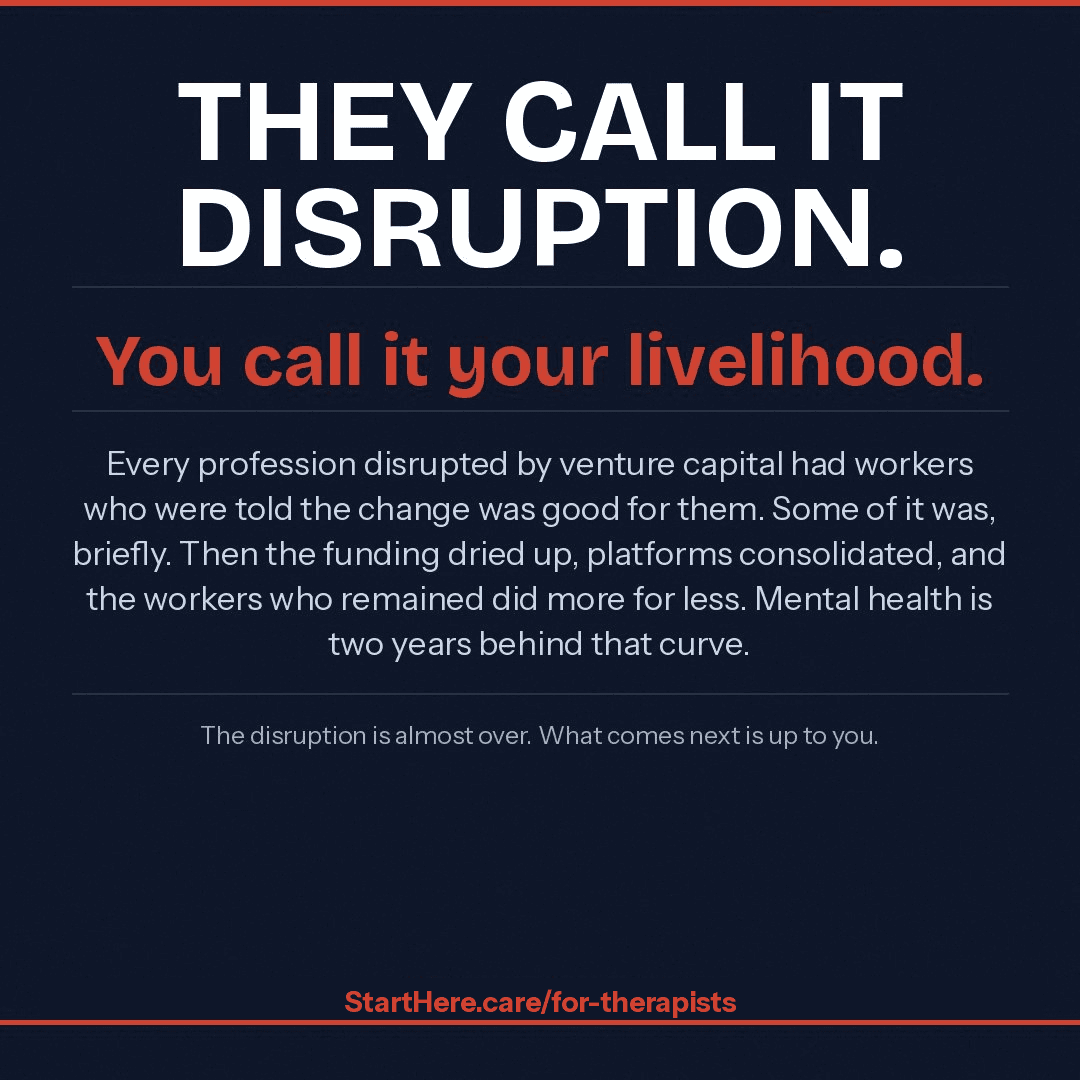
Investors have a 5–7 year exit horizon. Therapy doesn’t work on a 5–7 year exit horizon.
What Can Be Done About It
This is not a problem without solutions. But the solutions require deliberate effort across policy, practice, and platform design.
Policy Interventions
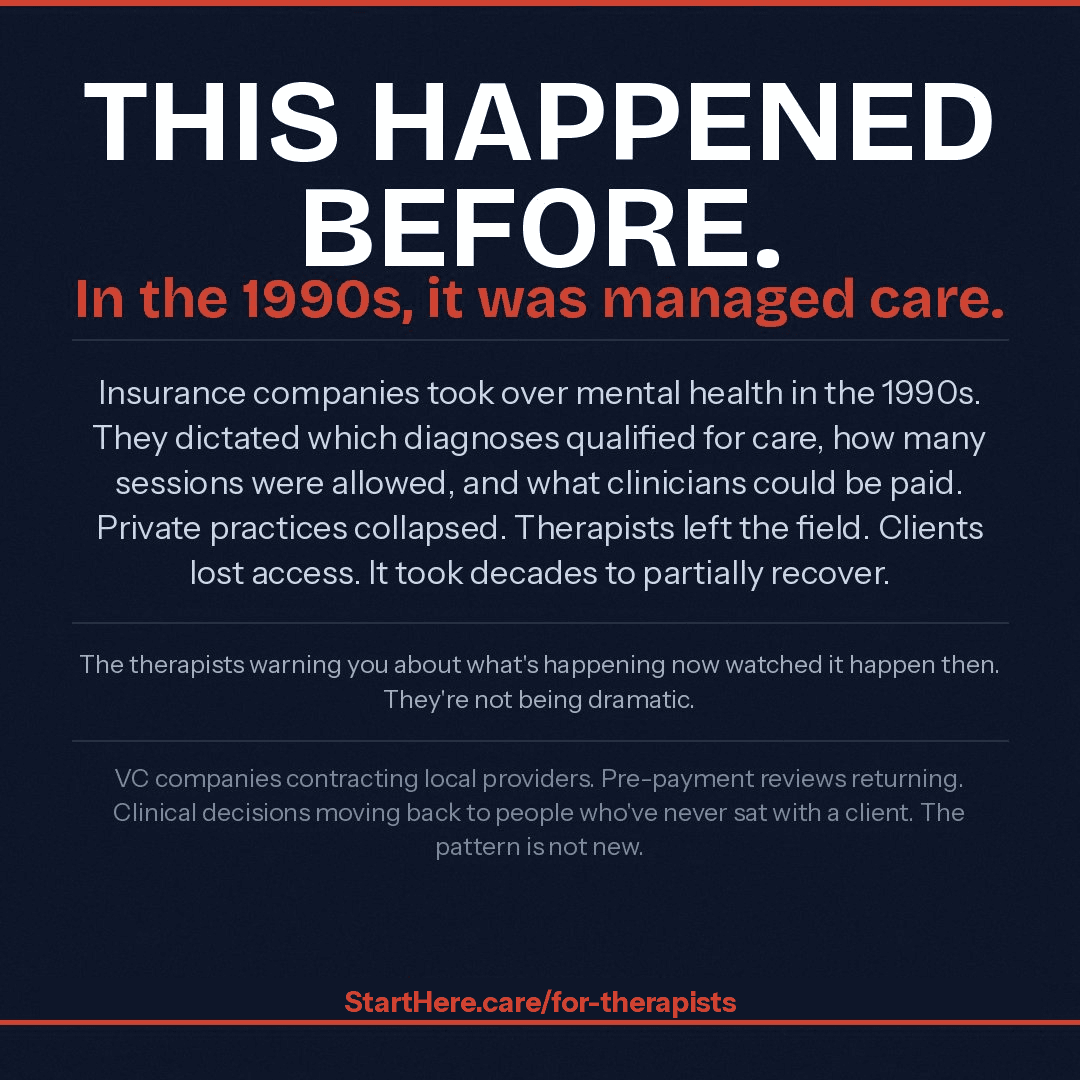
Parity enforcement is the foundation. The Mental Health Parity and Addiction Equity Act has been law since 2008, but enforcement has been weak. Strengthening parity enforcement, ensuring that insurance companies reimburse mental health care at rates comparable to medical care, would reduce the downward pressure on rates and create space for independent practice to be economically viable.
Regulatory scrutiny of PE acquisitions in healthcare more broadly, and mental health specifically, is overdue. The Federal Trade Commission has begun to pay more attention to healthcare consolidation, but mental health has received less focus than hospital systems and physician practices. That needs to change.
Loan forgiveness and workforce pipeline investment for mental health providers who practice in underserved communities would help counteract the incentive for new graduates to seek employment in higher-paying platform environments.
Provider Advocacy and Community Action
Mental health providers have significant collective power that they have not historically used. Professional associations can advocate for rate floors, credentialing equity, and ethical standards around caseload volume and platform employment contracts. Providers can collectively refuse to credential with platforms that impose unsustainable volume requirements.
Communities can build and support independent provider networks, cooperative practice structures, and community mental health centers that are explicitly not-for-profit and not subject to investor extraction.
Choosing Platforms That Are Built Differently
Clients and providers both have choices about which platforms and systems they participate in. Those choices, made in aggregate, shape the market. Platforms that are transparent about their ownership, their fee structures, their mission, and their business model create the conditions for more informed participation.
Why StartHere.care Is Built the Way It Is
Everything above describes a pattern: platforms that say they’re expanding access while suppressing provider pay. Platforms that say they’re reducing wait times while burning through therapists at unsustainable caseloads. Platforms that say they care about outcomes while optimizing for volume. The slogans sound right. The incentives point the other direction.
StartHere.care was built specifically so its incentives could never point that direction. It was not built to be sold. It was not built to generate a return for investors. It was not built with a 5-year exit horizon or a growth-at-all-costs mandate. It was built because the mental health system needed something that could not exist inside the VC model, and the founder had lived that need personally.
The platform is free to clients and free to providers. It is self-funded and VC-free by design, not by accident. That is not a limitation. It is a structural commitment. When there is no investor demanding a return, there is no reason to suppress reimbursement rates, no reason to push 40-client caseloads, no reason to credential hundreds of therapists under a group NPI just to fill panel slots.
Fit Over Speed
The center of StartHere.care is not an algorithm that matches clients to available therapists based on insurance coverage and appointment speed. It is a referral portal designed around fit and alignment, helping clients connect with providers who are genuinely suited to their needs, and helping providers receive referrals that match their areas of expertise and practice style.
This matters because therapeutic fit is one of the strongest predictors of clinical outcomes. A fast match that is a poor fit produces worse outcomes than a slightly slower match that is a good one. The corporate telehealth model optimizes for speed because speed looks good in an investor deck. StartHere.care optimizes for fit because fit is what actually helps people.
No Extracted Margin. No Funneling.
Every dollar that flows through StartHere.care goes to the provider or stays in the client’s pocket. There is no margin being extracted by a holding company, no percentage skimmed by investors, no fee for the algorithm. The platform exists to facilitate a connection, not to profit from the transaction that follows it.
When a VC-backed platform says “we connect people with care,” what they mean is: we connect people with care and take a cut. When StartHere.care says it, that is the entire sentence. There is nothing to extract. The connection is the product, and it is free.

A Mission Built to Last
The mental health epidemic is not going away. The need for accessible, quality, community-rooted mental health support is going to grow for years. The question is whether the infrastructure that develops to meet that need will be oriented toward the people it serves, or toward the investors who fund it.
StartHere.care is a bet that it is possible to build something durable, trustworthy, and genuinely useful without turning a public health crisis into a business opportunity. Not because profit is inherently wrong, but because this particular problem, at this particular scale, requires a platform that is accountable to the people it serves and nothing else.
The mental health epidemic is real. The gold rush is real. What we choose to build in the middle of both of those things matters enormously.
StartHere.care
Connecting clients with providers through fit, not just availability.
Ready to grow your practice?
Get matched with clients who fit your expertise. No listing fees. No per-lead charges.
Join the NetworkLooking for a therapist?
Tell us what you're looking for and we'll show you therapists who fit. No cost. No commitment.
Find Your MatchShare these graphics
Every image on this page is free to download and share. Post them on social media, text them to a colleague, put them in your waiting room, or send them to someone who thinks the therapy industry is fine. No credit needed, no permission required.
Browse all graphicsPennsylvania
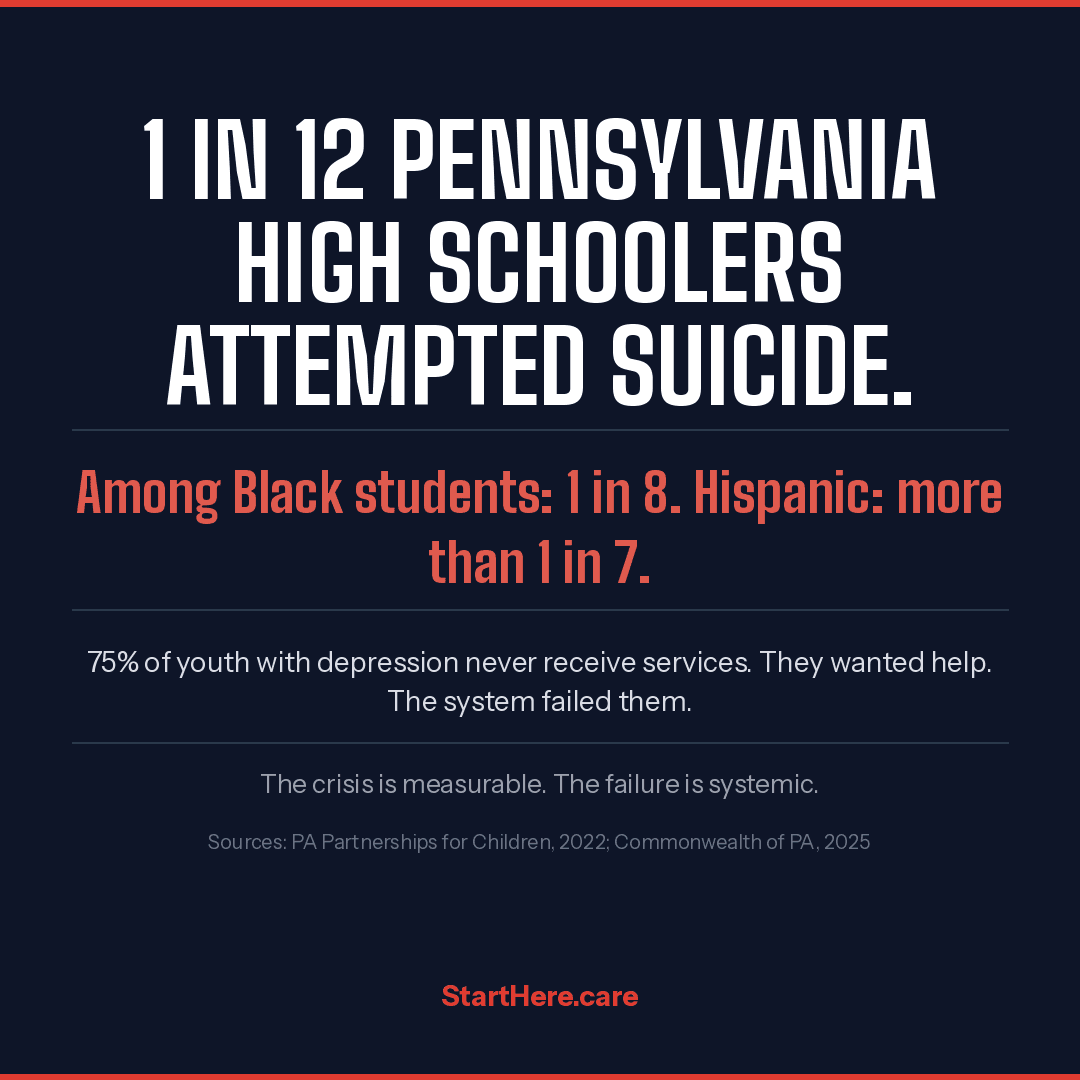
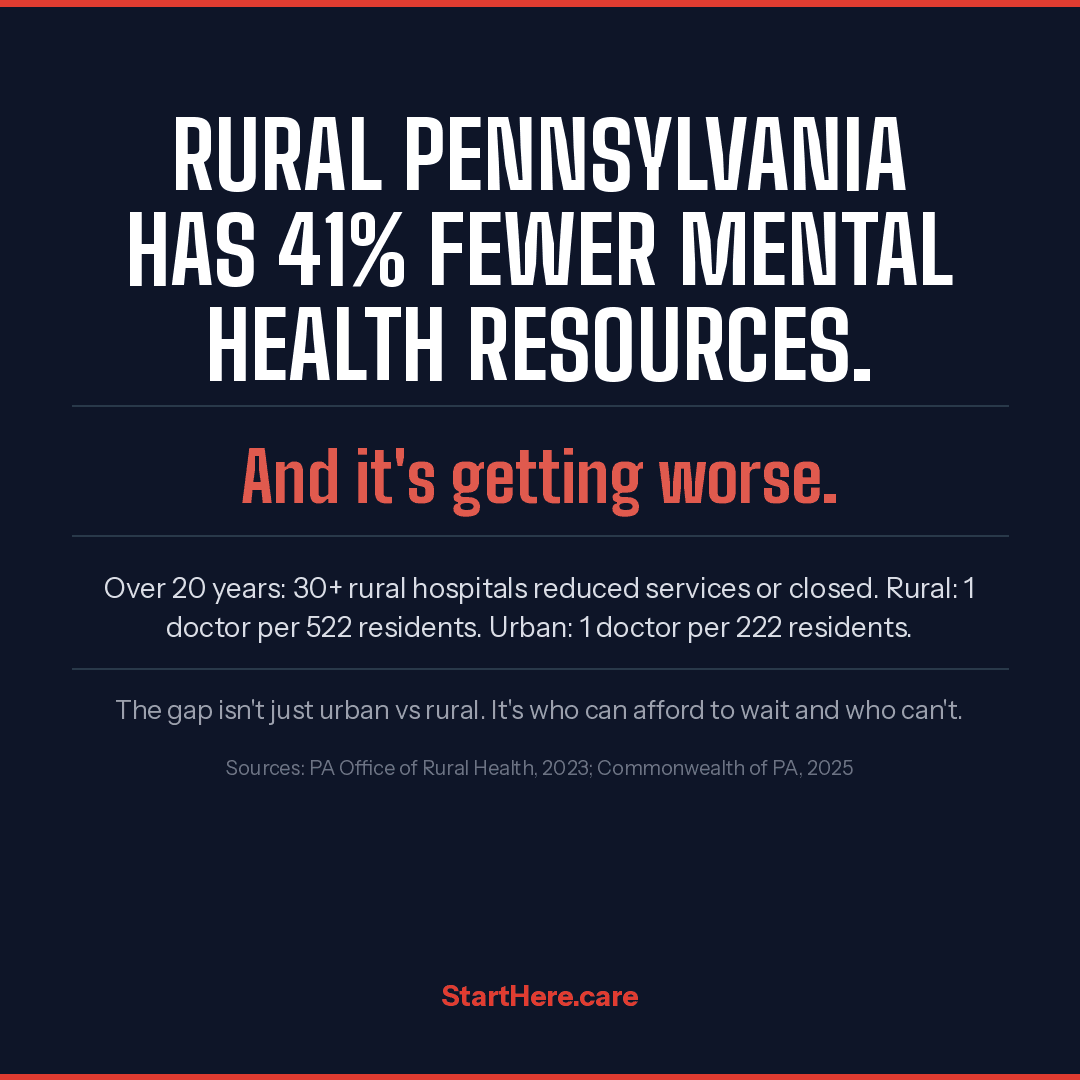
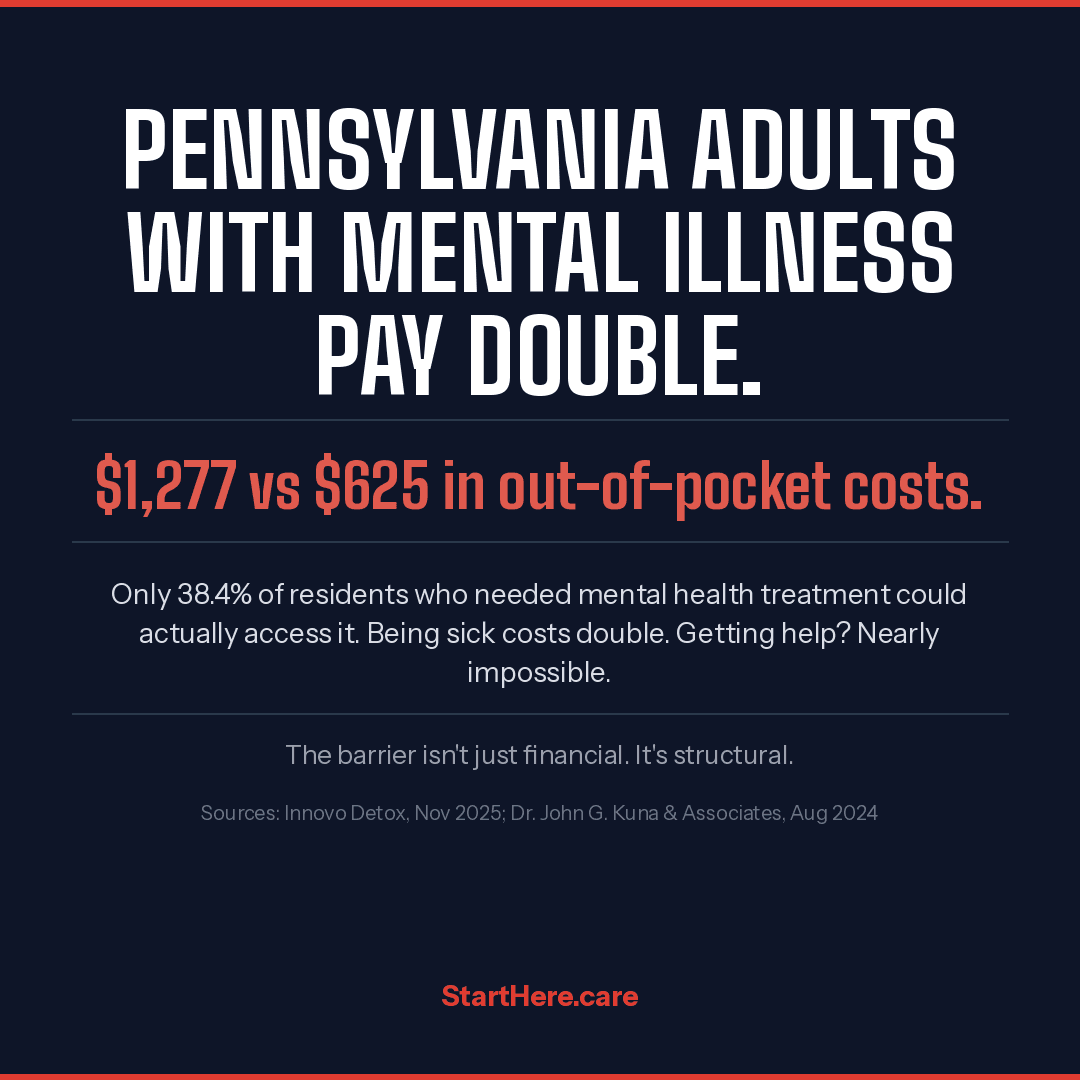
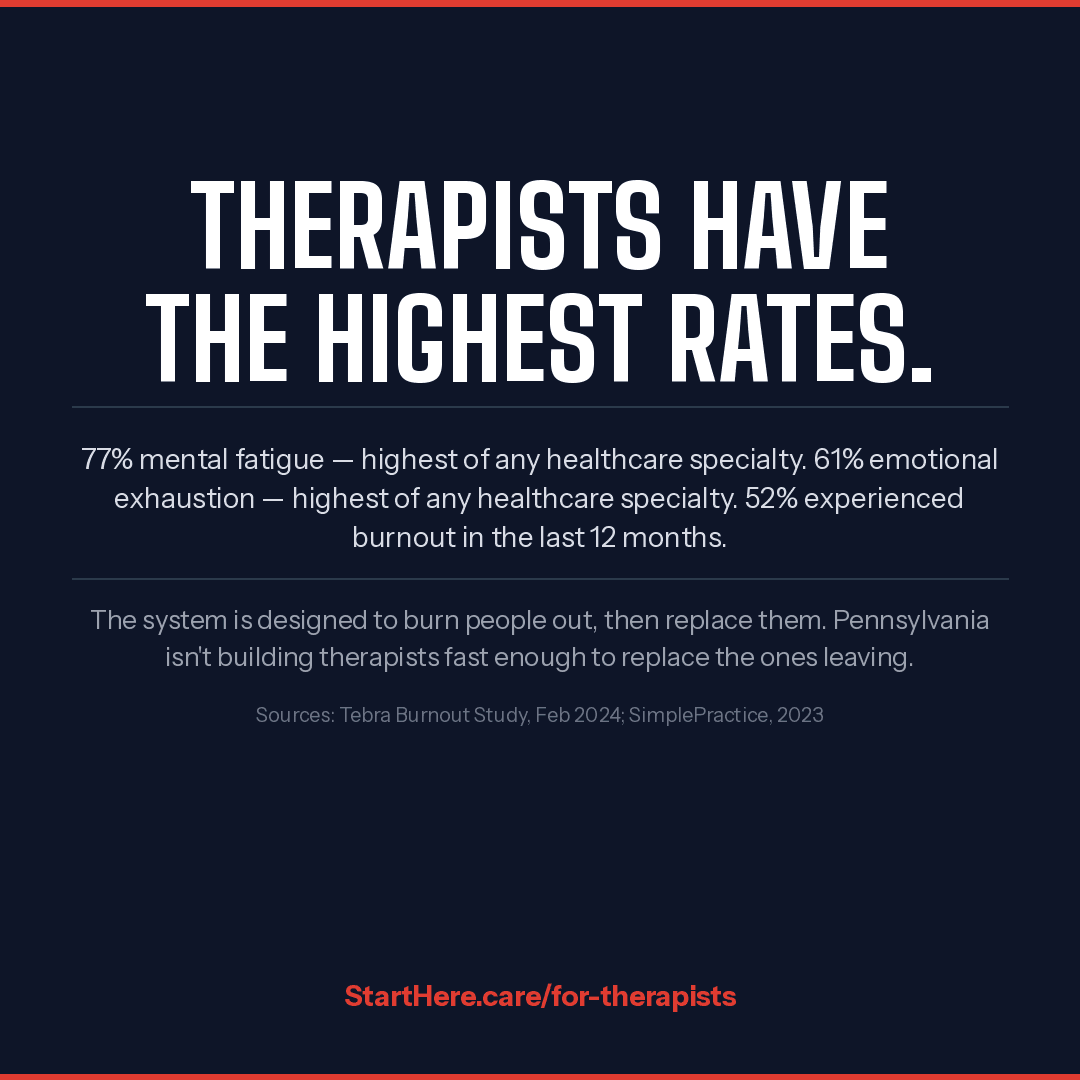
The numbers behind the crisis. Pennsylvania is short 6,300 mental health professionals, and the system is bleeding out.

For everyone
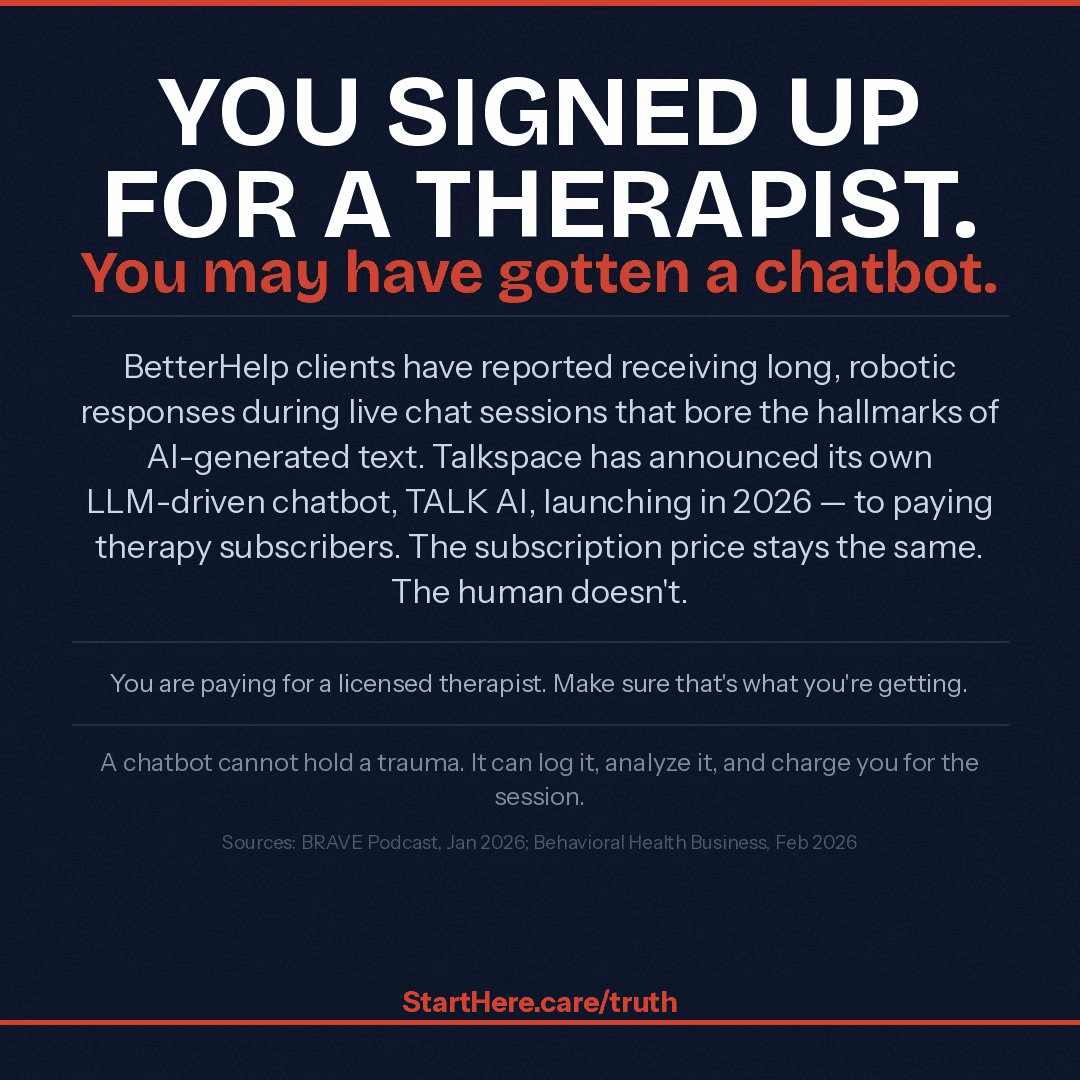
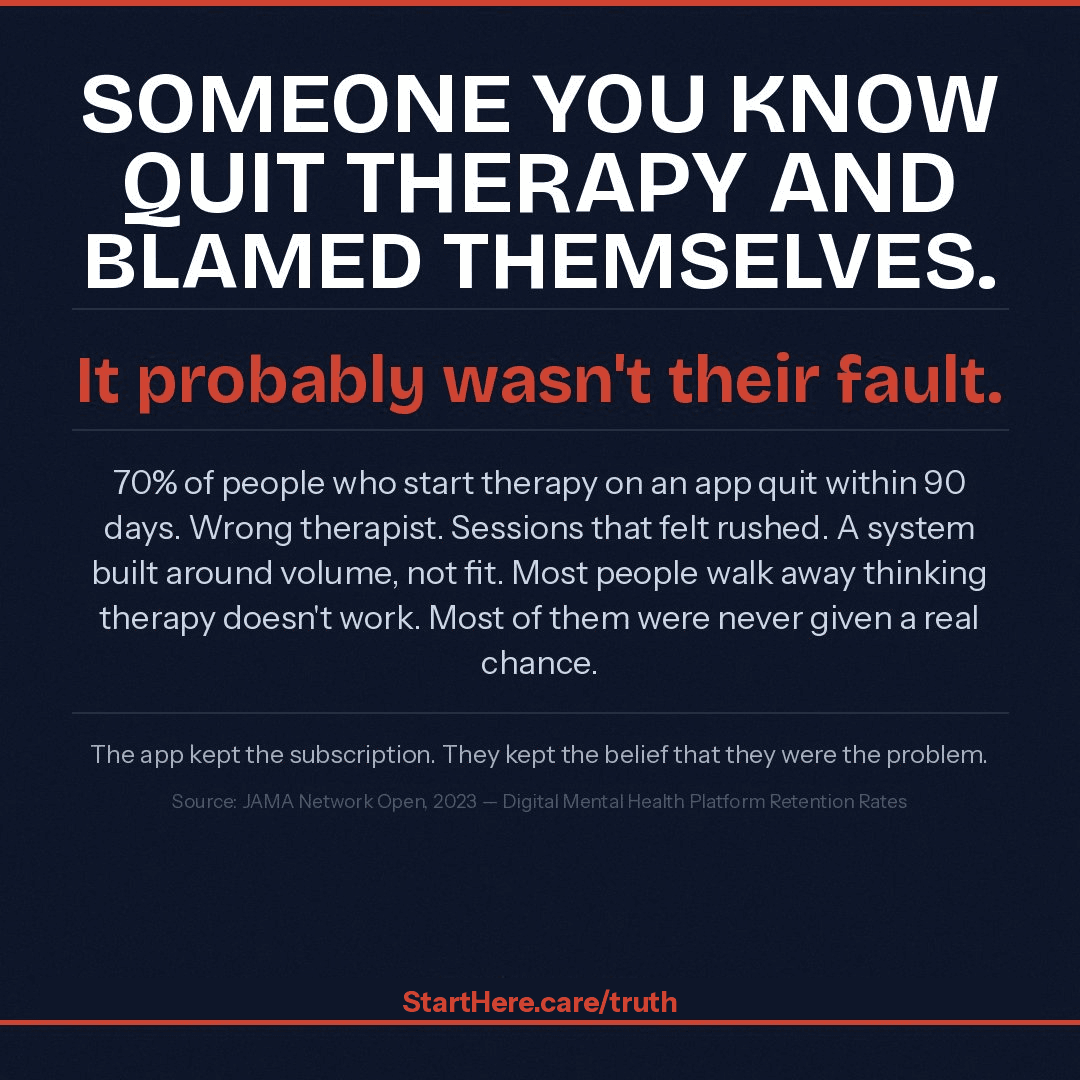
What clients and the public should know about where their money goes, who has their data, and why access keeps getting harder.
For therapists
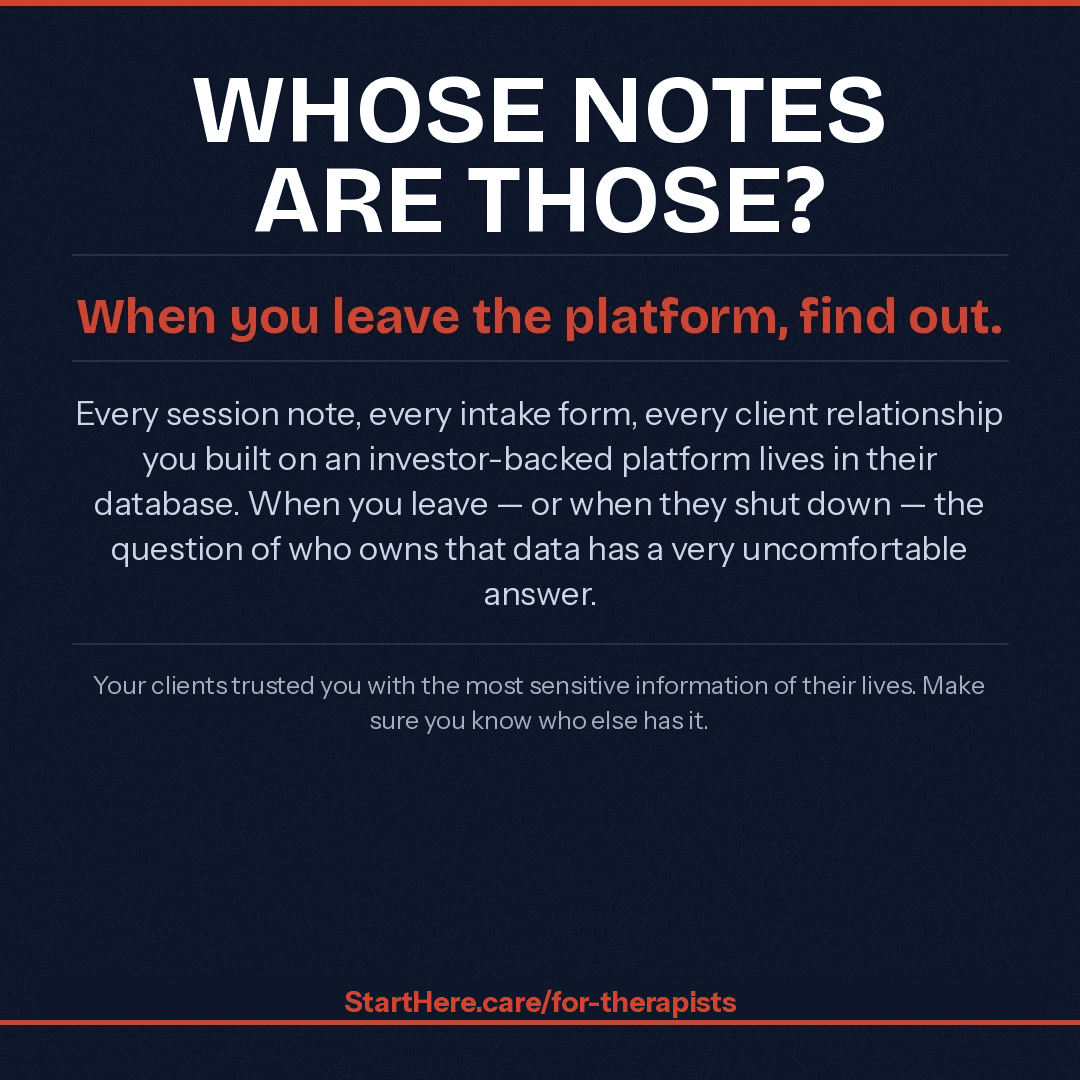
What the platforms aren't telling you about caseloads, pay, data ownership, and what happens to your clients when the funding runs out.

The VC playbook
The pattern is always the same: subsidize, capture, extract. Here's how it's playing out in mental health.