
Pennsylvania's Mental Health System Is Bleeding Out. We're Not Going to Let It.
We're opening client registration in Pennsylvania because the numbers don't lie, and they're worse than you think.
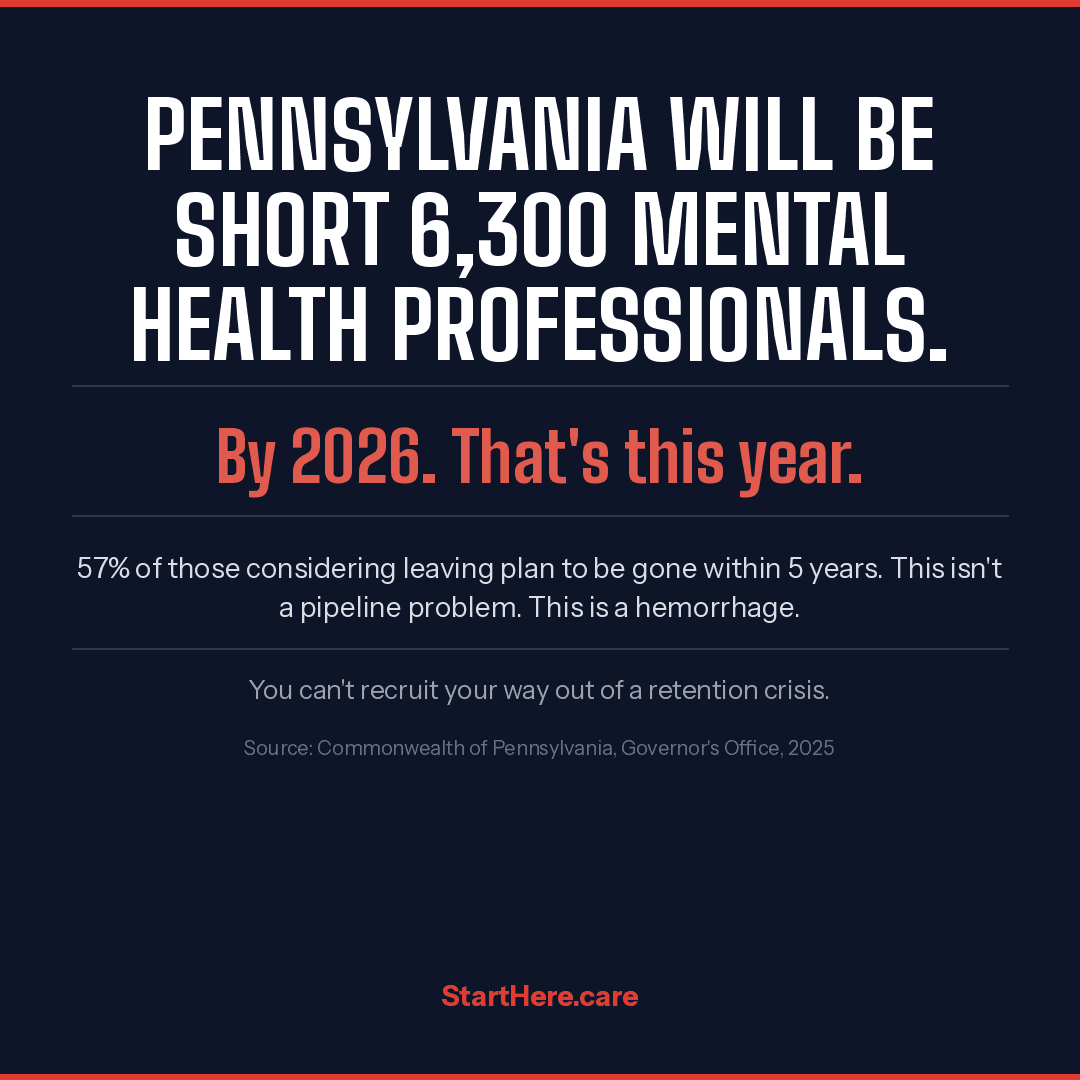
Pennsylvania is facing a shortage of more than 6,300 mental health professionals by 2026.1 That's not a projection anymore. That's this year. Meanwhile, 22.8% of adults in the state—1.83 million people—experienced a mental illness in 2022.2 Only 38.4% of Pennsylvanians who needed mental health treatment could actually access it.3 The rest? They're still looking.
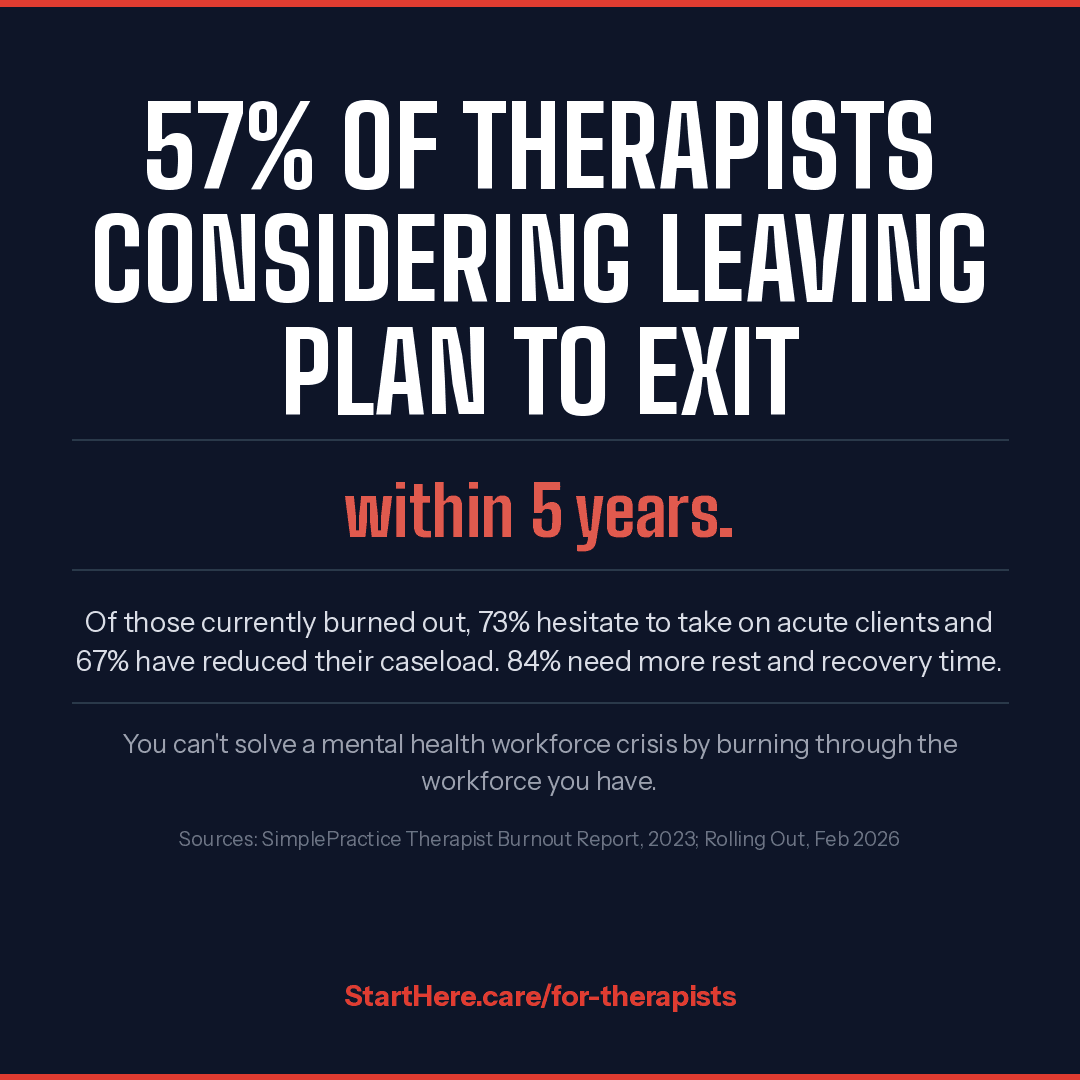
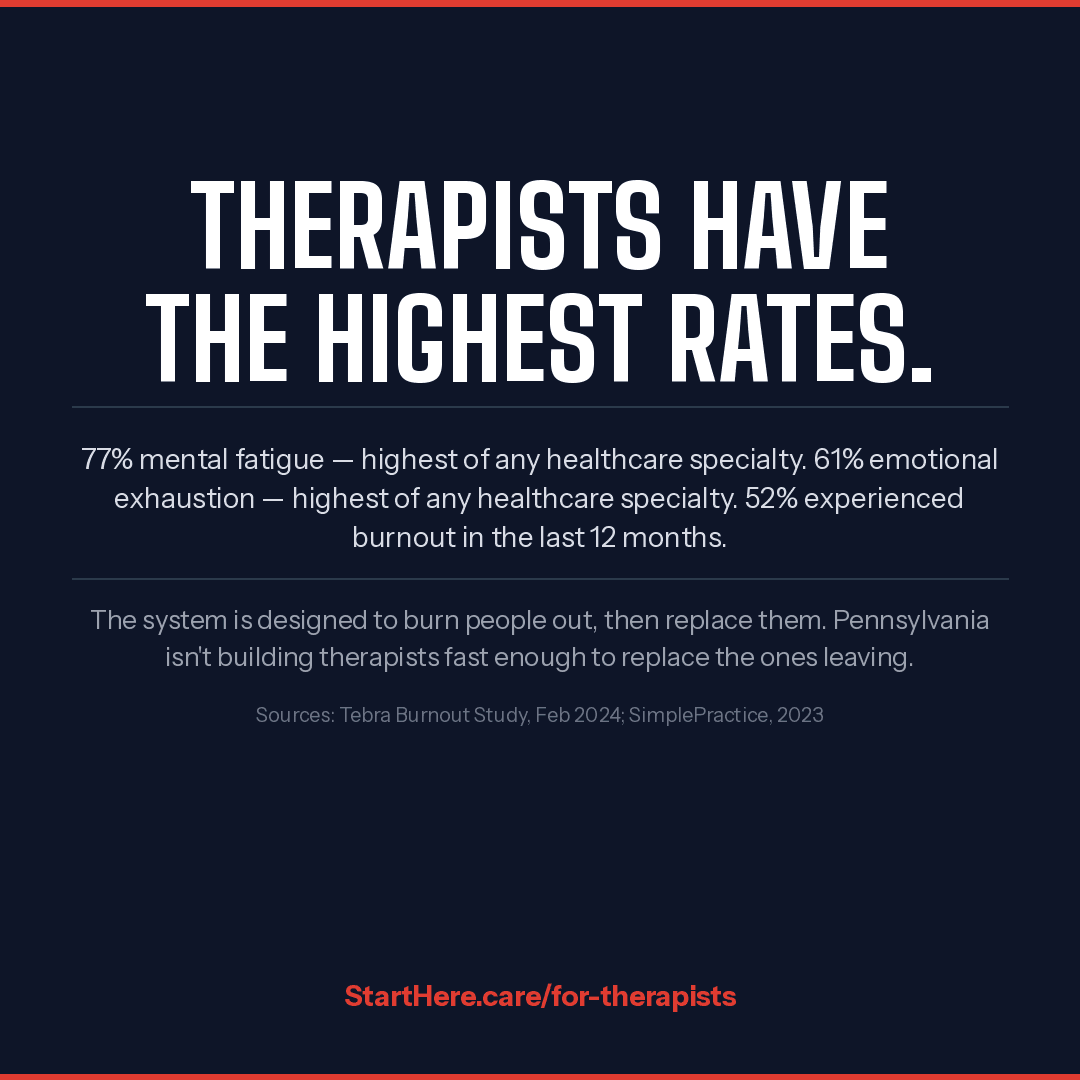
And the therapists who are still here? They're drowning. More than half report burnout.4 Therapists experience the highest rates of mental fatigue (77%) and emotional exhaustion (61%) of any healthcare specialty.5 Of those considering leaving the field, 57% say they'll be gone within five years.6
This isn't a pipeline problem. This is a hemorrhage.
The Pennsylvania Reality
Let's be specific about what's broken.
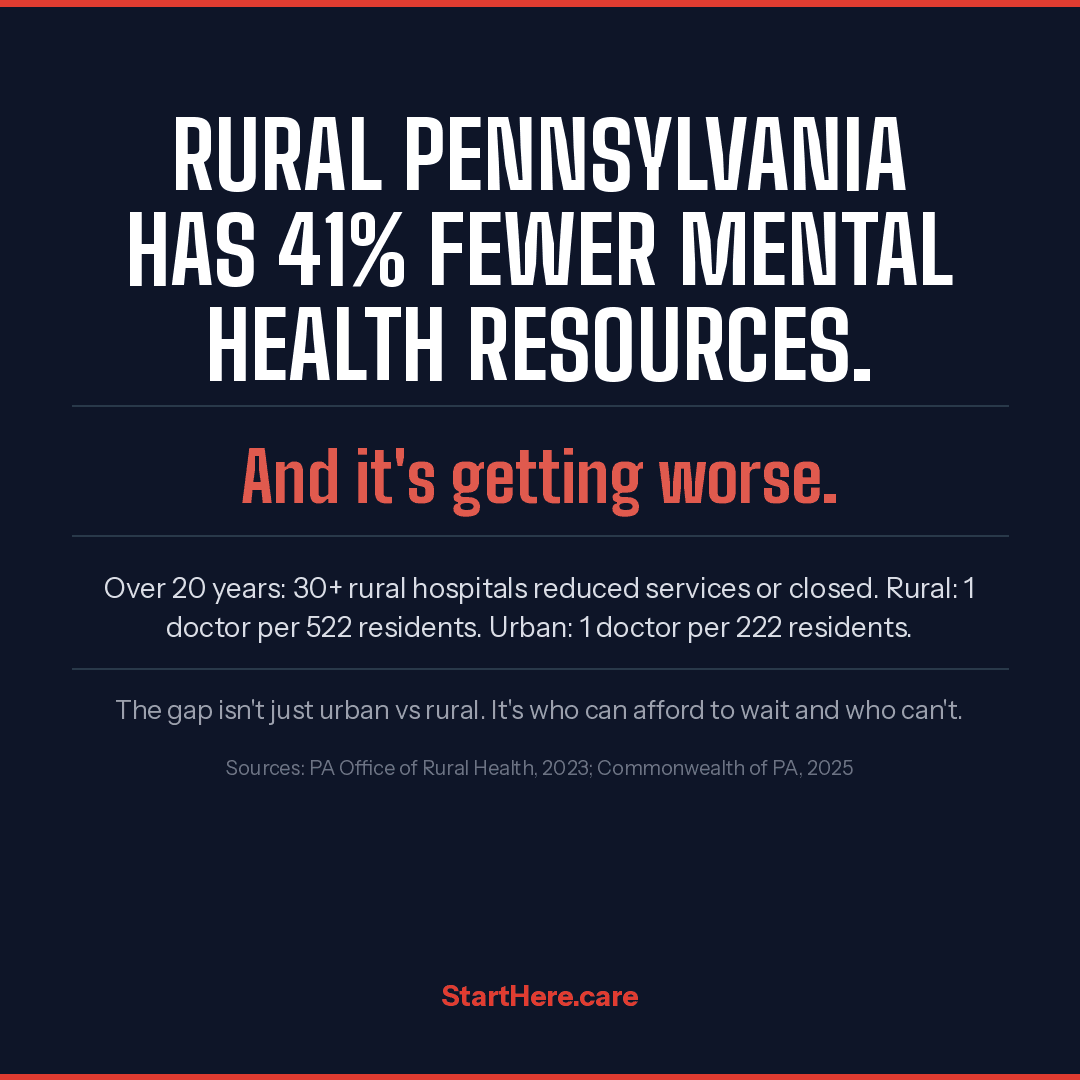
Rural Pennsylvania is a mental health desert. Rural counties have 41% fewer mental health resources than urban areas.7 Over the past 20 years, more than 30 rural hospitals have reduced services or closed entirely.1 In rural counties, there's one primary care physician for every 522 residents, compared to one for every 222 in urban areas.1 Behavioral health? Even worse.
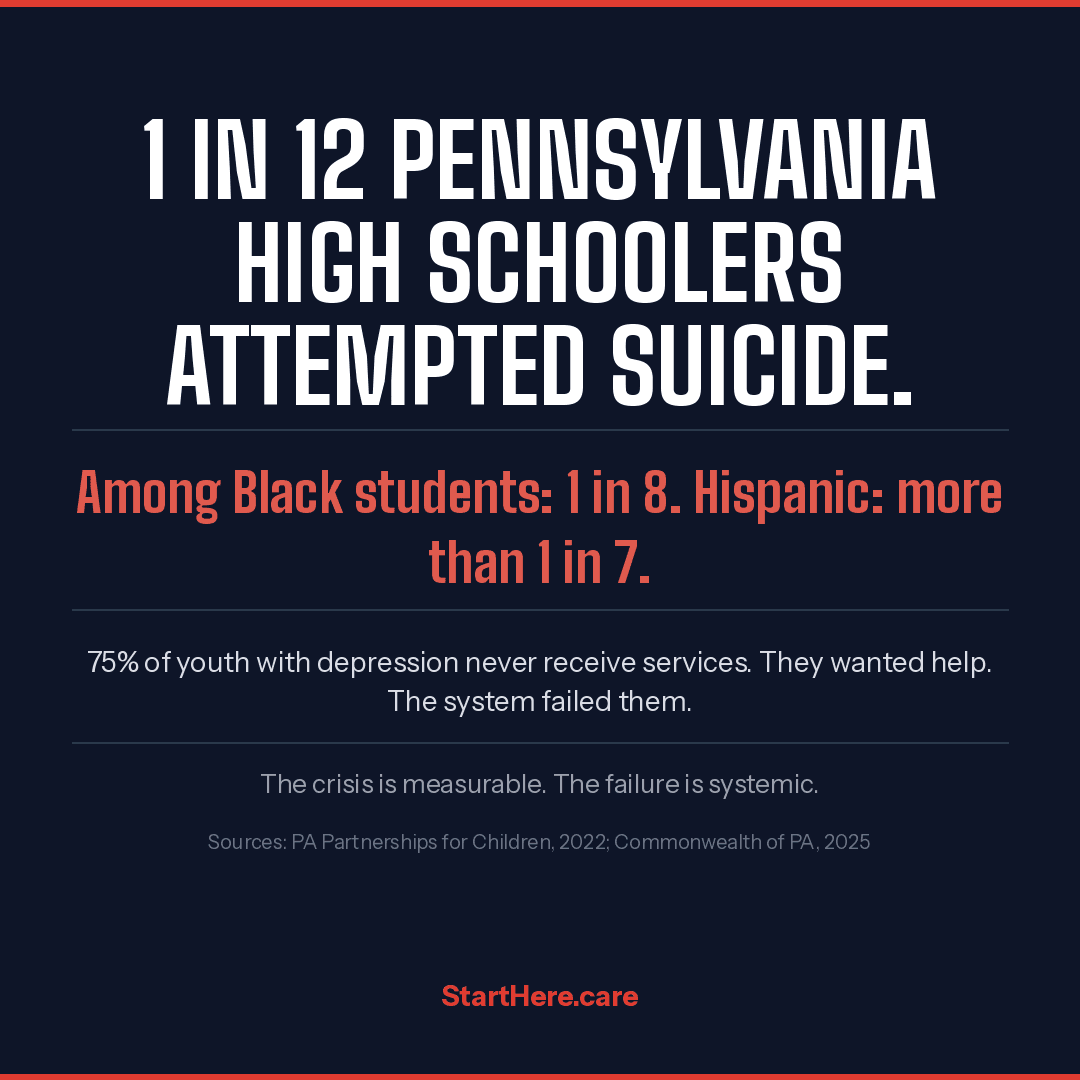
Children are getting crushed. The percentage of children with anxiety or depression jumped 26% nationally during the first year of COVID.8 In Pennsylvania, it jumped even higher. One out of every 12 high schoolers in the state attempted suicide. Among Black students, it's one in eight. Among Hispanic students, more than one in seven.8 And 75% of youth with depression never receive services.9
The ones who make it to the search can't find anyone. In May 2022, 22.6% of Pennsylvania adults experiencing anxiety or depression said they needed therapy but couldn't access it in the previous month.10 They wanted help. They were ready. The system failed them.
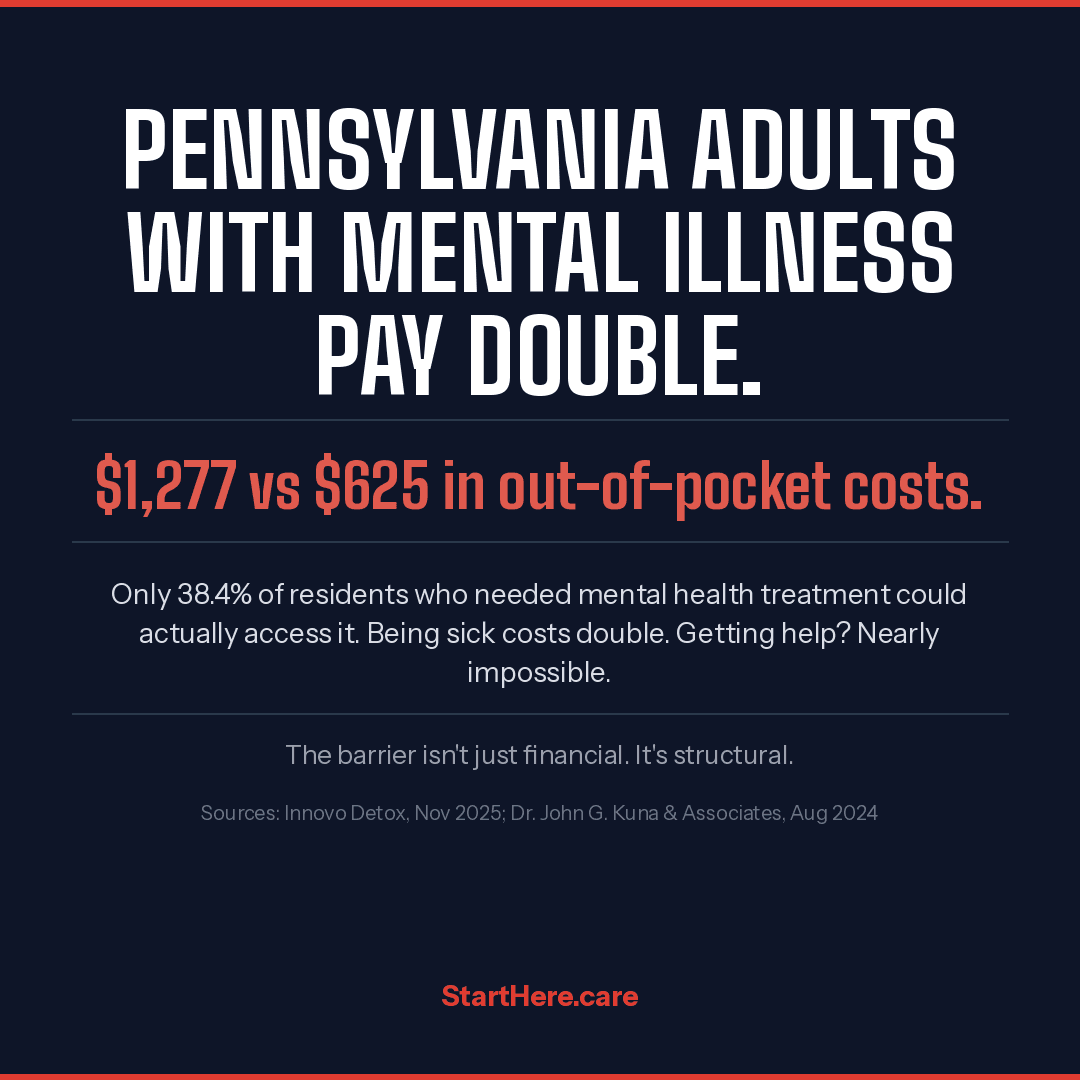
Cost is crushing access. Pennsylvania adults under 65 with mental illness pay more than double the out-of-pocket costs of those without: $1,277 compared to $625.11 Insurance reimbursement rates are so low that practitioners can't afford to take insurance. Clients can't afford to pay cash. The math doesn't work for anyone except the insurance companies.
And the workforce is collapsing. 52% of therapists experienced burnout in the last 12 months. 29% are currently burned out.4 Work-life balance is impossible when 50% of practitioners' schedules are completely filled every day,4 and taking time off means lost income. Administrative burden—dealing with insurance, documentation, getting meds approved—is eating practitioners alive.4
Nearly 40% of therapists have seriously considered leaving in the past year alone.6 When they leave, they take their expertise and their client relationships with them. Clients already struggling with mental health conditions face additional trauma when their therapist quits.12
Pennsylvania isn't building therapists fast enough to replace the ones burning out. The cost of education and student loan debt paired with low earning potential deters new professionals.13 The ones who do make it through training look at the field and see impossible caseloads, poor compensation, and burnout as an inevitability, not a risk. Some switch career paths before finishing their degrees.13
This is the system. And the system is broken.
What Venture Capital Did to Make It Worse
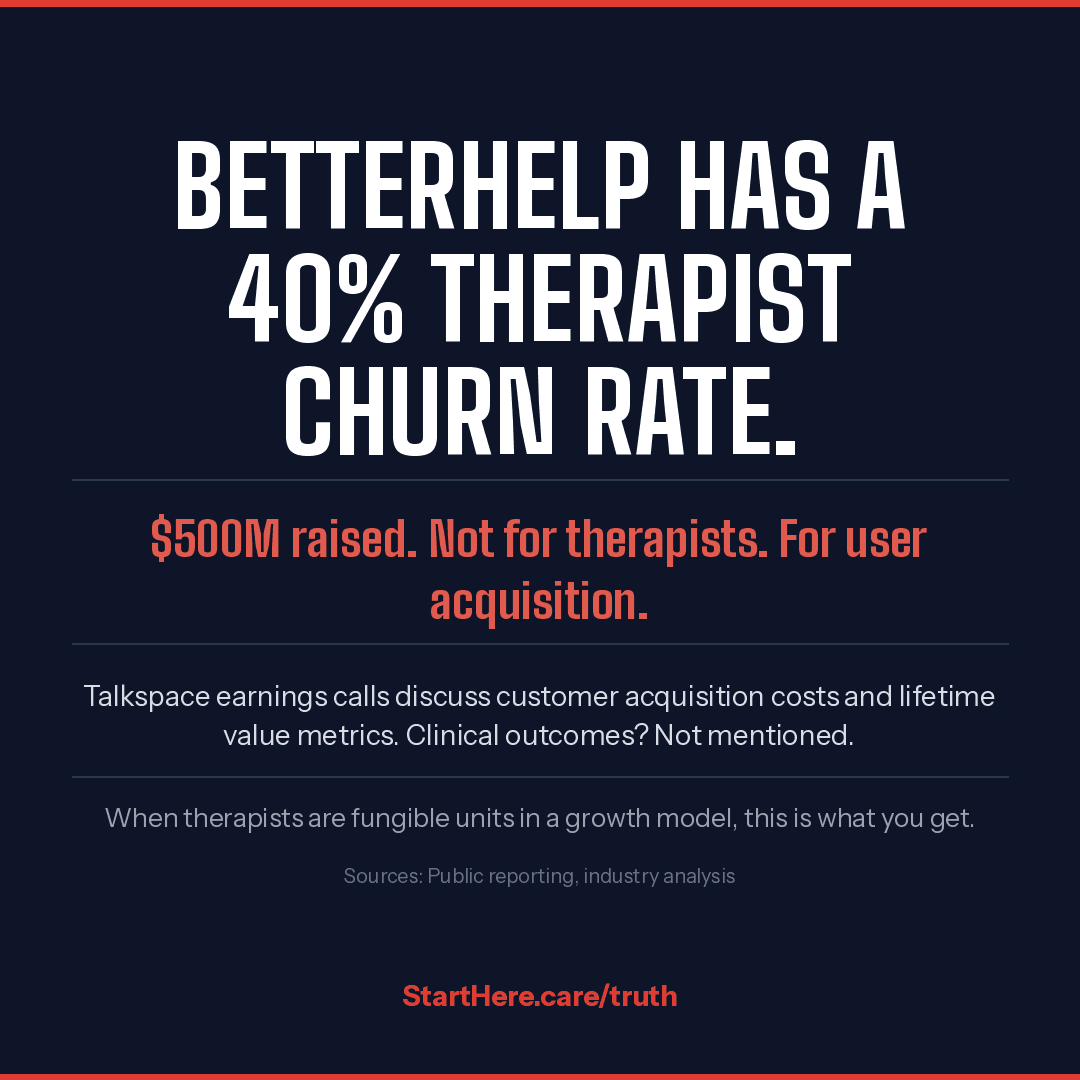
BetterHelp raised $500 million. They didn't use it to pay therapists more or reduce caseloads. They used it to acquire users faster than their competitors. When you take VC money, you answer to investors, not clients, not clinicians. The platforms optimized for scale. They built infrastructure that extracts from practitioners and fails clients.
BetterHelp has a 40% therapist churn rate. Talkspace went public. Their earnings calls discuss customer acquisition costs and lifetime value metrics, not clinical outcomes or practitioner satisfaction. The clients are the product. The practitioners are the infrastructure. The investors are the only stakeholders who matter.
Psychology Today charges practitioners $30/month to appear in search results clients don't trust anymore. OpenPath lists 89 therapists for all of Philadelphia—a city of 1.6 million people. The gap between what clients need and what they can actually find isn't a problem for the platforms. It's a business model.
We refuse to build that.
What StartHere.care Actually Is
We built StartHere.care as a purpose-driven project because watching venture capital monetize a crisis made us sick. We're not a marketplace. We're infrastructure. The platform exists to connect Pennsylvania clients with Pennsylvania practitioners based on actual clinical fit, then get out of the way. Read more about why we exist.
There are no fees. Not for practitioners. Not for clients. Not ever. This is not a gap in the business plan. This is the point.
We match based on fit—specialty, approach, availability, identity, lived experience—and present options to clients. The client chooses who to contact. We don't decide for them. We don't rank therapists. We don't hide options. We show matches and let the client make the call. The algorithm helps organize and filter, but the decision about who to reach out to belongs to the person seeking help.
Tired of paying for referrals that don't convert?
StartHere.care sends you clients matched on fit — not just zip code. No listing fees. No per-lead charges. No catch.
See How It WorksFor Pennsylvania practitioners:
- Create a profile clients can actually find
- Get matched with clients based on fit, not just zip code
- No listing fees, no revenue sharing, no extraction
- Control your availability, rates, specializations, approach
- Direct client contact—no platform-mediated messaging
Licensed in Pennsylvania and practicing anywhere in the US via telehealth? You're eligible. Credentialed with PA insurance panels? Clients can filter by that. Cash-only? Clients can filter by that too. Join StartHere.care here.
For Pennsylvania clients:
- A 3-minute intake focused on fit, not just insurance
- See therapists who match your preferences
- Direct contact information to reach out
- You decide who to contact—no gatekeeping, no platform making that choice for you
The system shows you practitioners whose profiles align with what you're looking for. You decide who to reach out to. We get out of the way. Start your search here.
The Numbers That Should Scare You
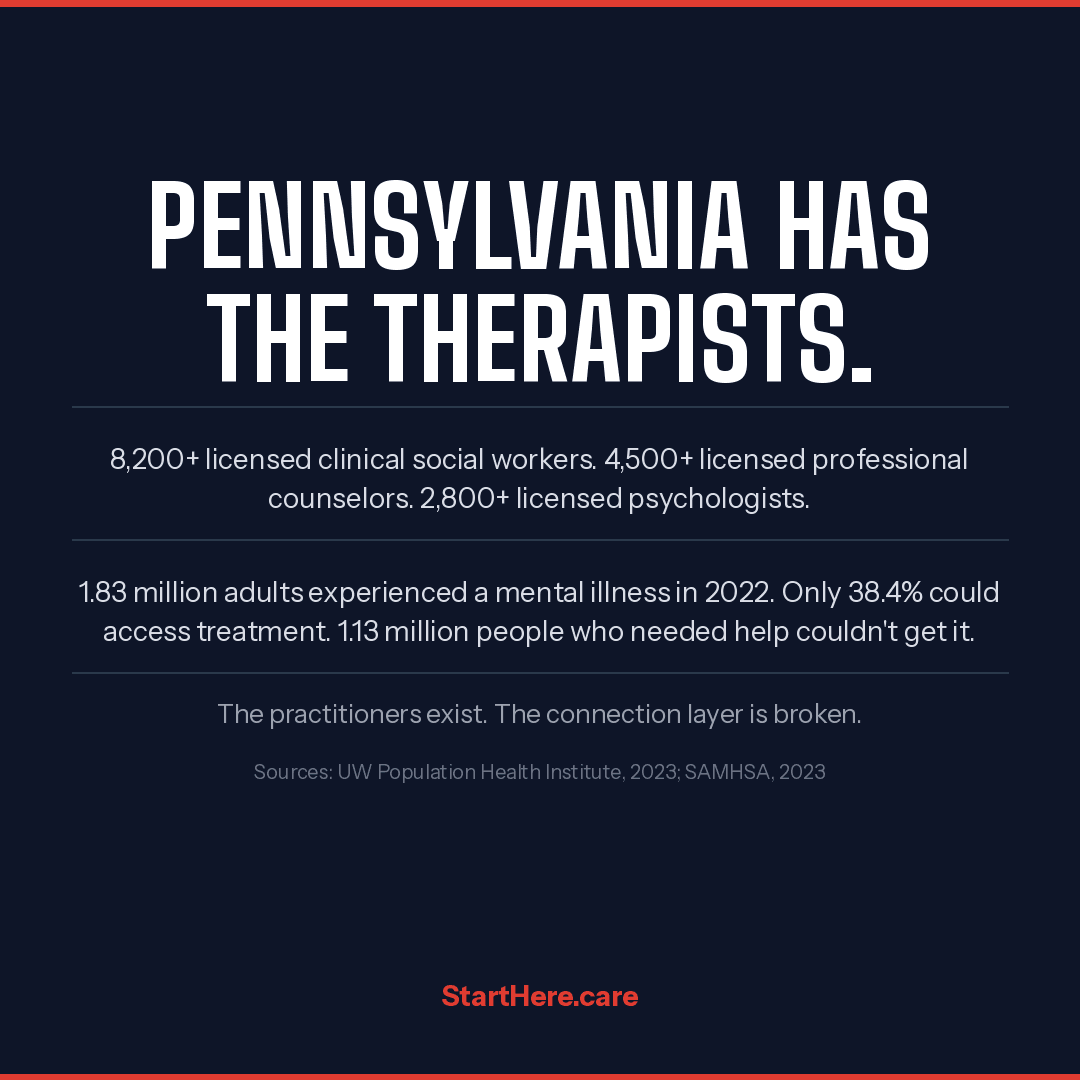
Pennsylvania has 8,200+ licensed clinical social workers, 4,500+ licensed professional counselors, and 2,800+ licensed psychologists.14 The practitioners exist. The capacity exists.
But 1.83 million Pennsylvania adults experienced a mental illness in 2022, and only 38.4% could access treatment.23 That's 1.13 million people who needed help and couldn't get it. Not because practitioners don't exist. Because the connection layer is broken.
The five-county Philadelphia metro has 6 million people. Pittsburgh metro has 2.3 million. Harrisburg, Allentown, Scranton, Erie, Reading—Pennsylvania has dense population centers surrounded by rural counties with almost no resources. Clients search "therapist near me" and get the same five platforms running the same extraction model. They fill out intake forms that feed into systems prioritizing therapist availability over clinical compatibility. They get matched with whoever has an open slot, not who can actually help them.
That's not matching. That's inventory management.
47% of adults nationally with mental illness go completely untreated.15 Not because they don't want help. Not because practitioners don't exist. Because the path to finding them is a mess of outdated directories, opaque insurance requirements, cold intake forms, and platforms that prioritize their own growth over clinical fit.
The Workforce Crisis Isn't Theoretical
More than 6,300 mental health professionals short by 2026.1 57% of those considering leaving plan to be gone within five years.6 29% of practitioners are currently burned out, and 49% say their burnout has gotten worse since COVID.4
When burnout hits:46
- 73% of practitioners hesitate to take on severe or acute clients
- 67% reduce their caseload
- 76% feel more tired
- 84% need more rest and recovery time
- 64% feel emotionally drained
- 39% have difficulty engaging in personal activities
This is what happens when you build a system that penalizes practitioners for prioritizing their own wellbeing. Taking time off means lost income for private practitioners. Reducing caseloads to manageable levels creates financial strain. The system is designed to burn people out, then replace them. Except Pennsylvania isn't building practitioners fast enough to replace the ones leaving.
The mental health crisis isn't getting better. It's accelerating. And the infrastructure designed to connect people to help is optimized for profit, not outcomes.
This Isn't a Launch. This Is a Stand.
We built StartHere.care in Michigan first. We tested the intake process, the matching logic, the practitioner profile system, the referral tools with real therapists and real clients. It worked. Now we're opening the platform to Pennsylvania practitioners and clients because the infrastructure is ready and the need is screaming.
We're not running a pilot. We're not in beta. This is the platform, fully operational, available today, purpose-driven, no fees, no extraction.
Pennsylvania deserves better than watching its mental health system bleed out while platforms optimize for investor returns. Practitioners deserve infrastructure that doesn't exploit them. Clients deserve a way to find help that doesn't require navigating a broken system at the exact moment they're least equipped to do it.
We're here. We're open. We're not going anywhere.
Pennsylvania therapists: Join StartHere.care here. Create your profile in about five minutes.
Pennsylvania clients: Start your search here. Three-minute intake. No cost. No gatekeeping.
Questions about how the platform works? Reach out directly at Jeff@StartHere.care.
Sources
- Commonwealth of Pennsylvania, Governor's Newsroom. "PA Health Care Providers Serving Rural Communities Talk Shapiro's Budget." 2025.
- Substance Abuse and Mental Health Services Administration (SAMHSA). "Behavioral Health Barometer: Pennsylvania." 2021-2023.
- Dr. John G. Kuna and Associates. "The State of Mental Health in Pennsylvania." August 2024.
- SimplePractice. "Therapist Burnout Report." 2023.
- Tebra. "Physician Burnout by Specialty 2025: Navigating Stress in the Healthcare Industry." February 2024.
- Rolling Out. "Therapist Burnout Drives Mass Exodus from the Field." February 2026.
- Pennsylvania Office of Rural Health. "Mental Health Workforce Distribution." 2023.
- Pennsylvania Partnerships for Children. "Pennsylvania Ranks 21st in Nation for Child Well-Being." August 2022.
- Commonwealth of Pennsylvania. "PA Health Care Providers Serving Rural Communities." 2025.
- KFF (Kaiser Family Foundation). Mental Health and Substance Use State Fact Sheets. 2022.
- Innovo Detox. "Mental Health Disorder Statistics: Pennsylvania." November 2025.
- SimplePractice. "Why Therapists Are Burning Out." 2023.
- The Council of State Governments. "Mental Health Matters: Addressing Behavioral Health Workforce Shortages." October 2024.
- University of Wisconsin Population Health Institute. "County Health Rankings & Roadmaps." 2023.
- Mental Health America. "The State of Mental Health in America." 2023.